Spain is throwing electricity away. Between January and June 2026, 2.5 TWh of renewable generation could not be absorbed by the grid —more than was wasted in the whole of 2024—, with a record-breaking June: 1.2 TWh curtailed in a single month, almost six times more than the June before. In parallel, the country has now clocked up more than 500 hours of negative prices on the wholesale market: moments when there is so much spare energy that some generators pay for the privilege of producing.
The problem is not that there is “too much sun”. It is that we have rolled out solar generation far faster than grids, flexible demand and storage. And for anyone with panels on the roof, that translates into an uncomfortable sentence: the kilowatt hour you export at midday is worth less and less.
What has changed for your system
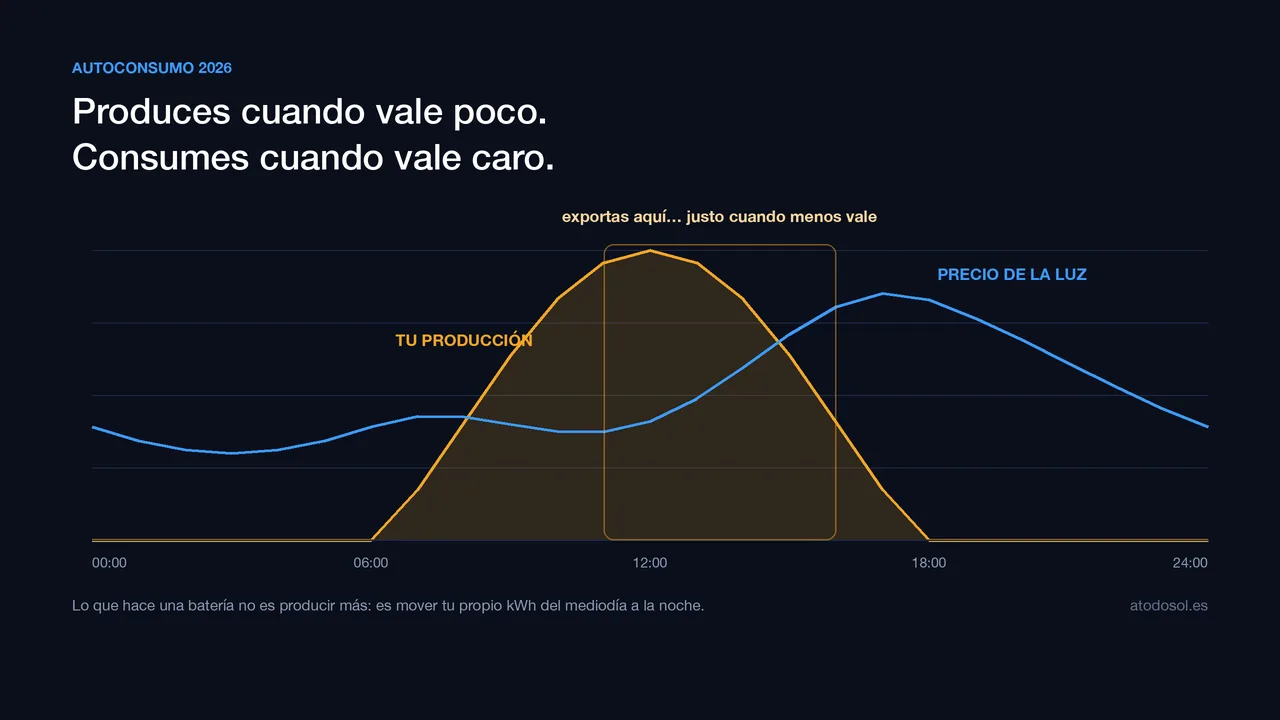
For years the sales pitch was simple: “whatever you don't use gets credited on your bill”. That is still true, but the price of that credit collapses precisely during the hours when your roof is producing flat out. The middle of the day is when the whole system generates the most solar: exactly when you export, so does everybody else.
Meanwhile, the electricity you buy in the late afternoon and evening —when you switch the oven on, charge the car or run the air conditioning— is paid for at expensive-hour prices. That widening gap between what you are paid and what you pay is what has changed the sums. And it is why in 2026 the conversation has moved from the panel to the battery.
The market is already showing it
UNEF's figures for 2025 describe a sector running at two speeds:
- 1,139 MW of self-consumption were installed, 3.7% less than in 2024.
- Residential fell by 17%: 36,330 new homes and 229 MW.
- Storage paired with self-consumption grew by 119%, from 155 to 339 MWh.
And across the system as a whole the acceleration is sharper still: installed battery capacity grew by 589% between April 2025 and April 2026, from 28 to 193 MW, according to Fundación Renovables. The blackout of 28/04/2025 did the rest: anyone who sat through it in the dark stopped seeing a battery as an efficiency accessory and started seeing it as risk management.
In plain terms: fewer new panels are going up, but the ones that do go up come with a battery far more often.
What a battery really does (and what it doesn't)
It is worth understanding this without the marketing, because whether the investment makes sense or not depends on it.
What it does. It takes the surplus from 14:00 —the one that today is paid at bargain-basement prices— and hands it back to you at 21:00, when the alternative is buying it dear. It does not generate a single extra kWh: it moves the ones you already produce through time. That shift is the whole business case.
What it doesn't do. It does not “earn money” by exporting: in Spain the surplus is credited on your bill, it is not sold on the market like a power plant. And it does not automatically turn your house into an island during a blackout: for that, the system has to be built to run isolated from the grid, with the critical loads wired to that circuit. There are batteries that give no backup at all, and there is backup that only feeds a handful of sockets. Always ask what will stay on, not whether it “has backup”.
When a battery pays for itself… and when it doesn't
We are installers and we will say it anyway: there are houses where a battery does not pay for itself.
It usually pays off when:
- Your consumption is concentrated in the afternoon and evening, and the house is empty during the day.
- You have a systematic midday surplus with the system already sized.
- You charge an electric car or have heating and cooling you can shift.
- Backup matters to you: you live somewhere with power cuts, or you depend on electricity for your work, a borehole pump, a business or a medical need.
It usually doesn't pay off when:
- Your consumption is low (a small bill leaves little margin to optimise).
- You consume mostly during the day and already self-consume nearly everything you produce.
- Your roof is undersized: if you barely export, there is nothing to store. Before a battery, the sensible move is sometimes more panel capacity.
- You are after short-term “returns” measured against the panels: it is not the same product, nor the same timescale.
If someone offers you a battery without having looked at your hourly consumption curve, they are not sizing anything: they are selling you a catalogue product.
What almost nobody tells you about afterwards
A battery is the hardest-working component in your system: a daily cycle, heat, power electronics and communications. Over time you get module imbalances, BMS errors, charging windows left misconfigured after a firmware update, or a dongle that has dropped off and leaves you blind.
That is where the wheat is separated from the chaff: we watch our plants every day —voltages, strings, actual output against expected— and raise a ticket when something drifts, instead of waiting for the customer to notice that their bill has gone up. We explain it in detail in Your system can be perfect… and still fail.
In one sentence
2026 is not the year for putting up more panels: it is the year for keeping the kWh you already produce. If your system exports a lot at midday and you buy expensive at night, the conversation to have is about storage —with the numbers from your own house, not from a generic table—.
Request your free, no-obligation study · or message us on WhatsApp · 692 22 97 13
Sources: curtailment and negative price figures for the first half of 2026 published by El Periódico de la Energía and Infobae (August 2026); 2025 self-consumption figures from UNEF (January 2026); battery capacity trend, Fundación Renovables (April 2026).