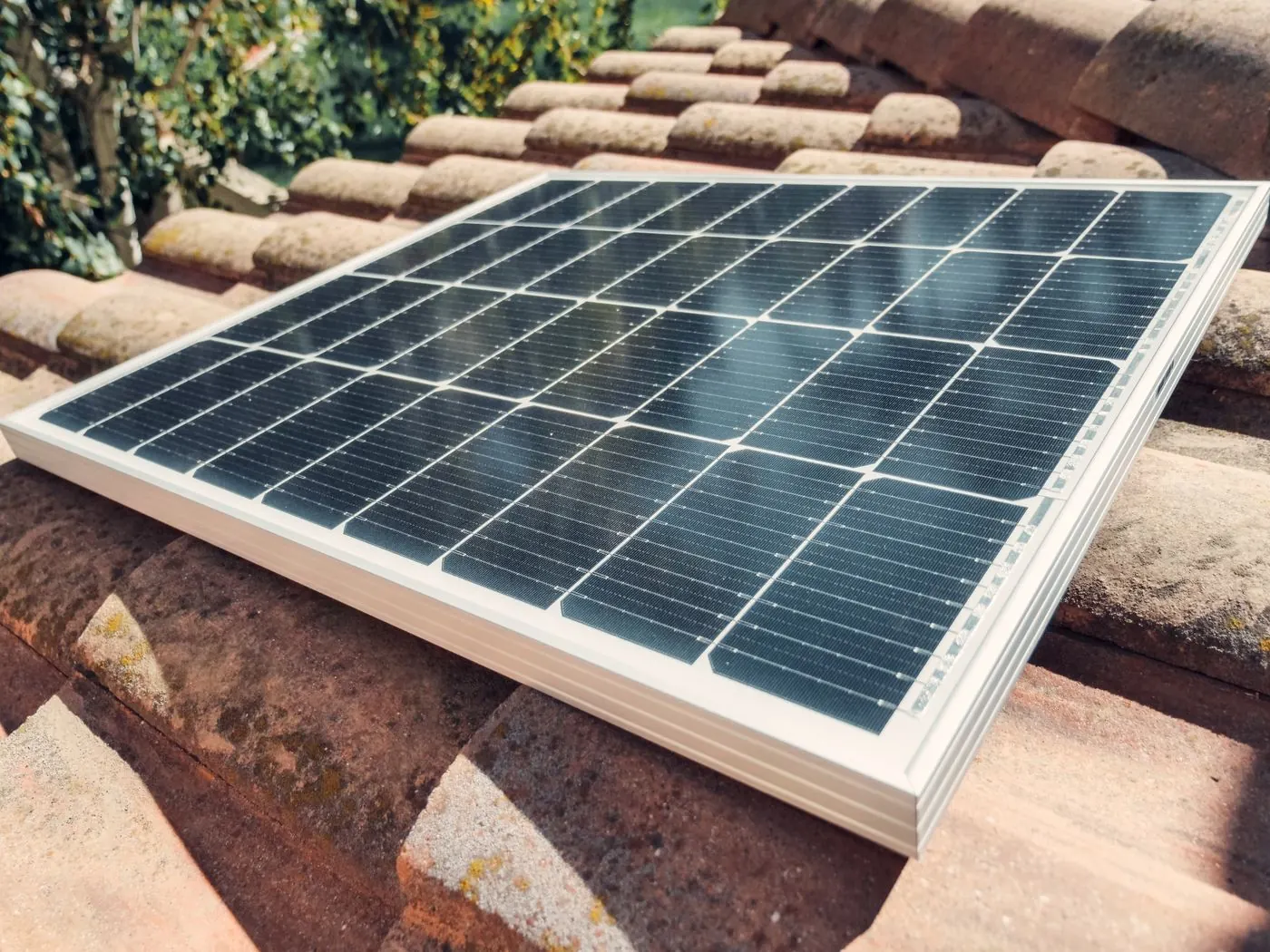
The market no longer makes “normal” panels. The 2026 standard product is bifacial: it produces on both faces, it is glass–glass, and it uses an n-type cell. If someone offers you a monofacial to save €3 or €4 per panel, they are offering leftover stock, a worse cell, or a bifacial with an opaque plastic sheet glued on the back. On a system that has to last more than thirty years — a little more than a third of an average human life — that “saving” is ridiculous. And no, a red tile roof does not change it. Neither does a cloudy day.
What a bifacial panel is (no marketing)
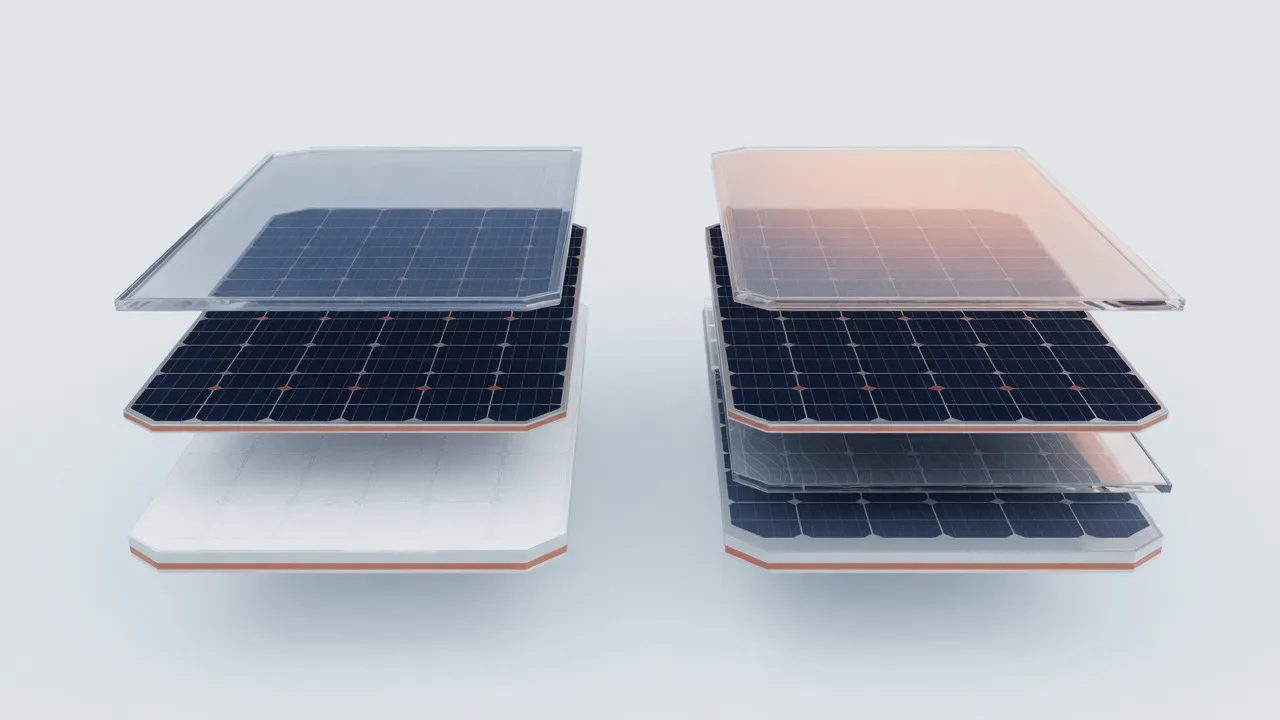
A solar panel turns light into electricity. A classic monofacial uses only the sky-facing side: the back is an opaque plastic sheet. A bifacial module keeps both faces active. The front does exactly what it has always done. The rear uses three things the plastic used to throw away:
- light that bounces off the roof, the tiles, the gutter, the wall, the neighbour’s tiles;
- diffuse skylight that slips in at the edges, the eaves and the gap under the frame;
- light that clouds send back down on the days “there is no sun”.
Monofacial
Bifacial
The rear-side gain is not 30 % on a house roof. Anyone selling you that is lying. On a pitched roof the extra usually sits in an honest range of 2 to 8 %, depending on albedo, air gap, rows and climate. Over thirty years, that is a fortune. The 30 % exists: on the ground, with light gravel, snow or a white membrane, and with the module raised. That is not your house. It does not need to be.
There is a second difference, and this one alone already wins the argument: a serious bifacial today is glass–glass. The monofacial they want to slip in is usually glass–plastic. Plastic yellows, micro-cracks, lets moisture in and degrades faster. Glass does not. Even if the rear produced zero — and it does not — the bifacial is still the better panel.
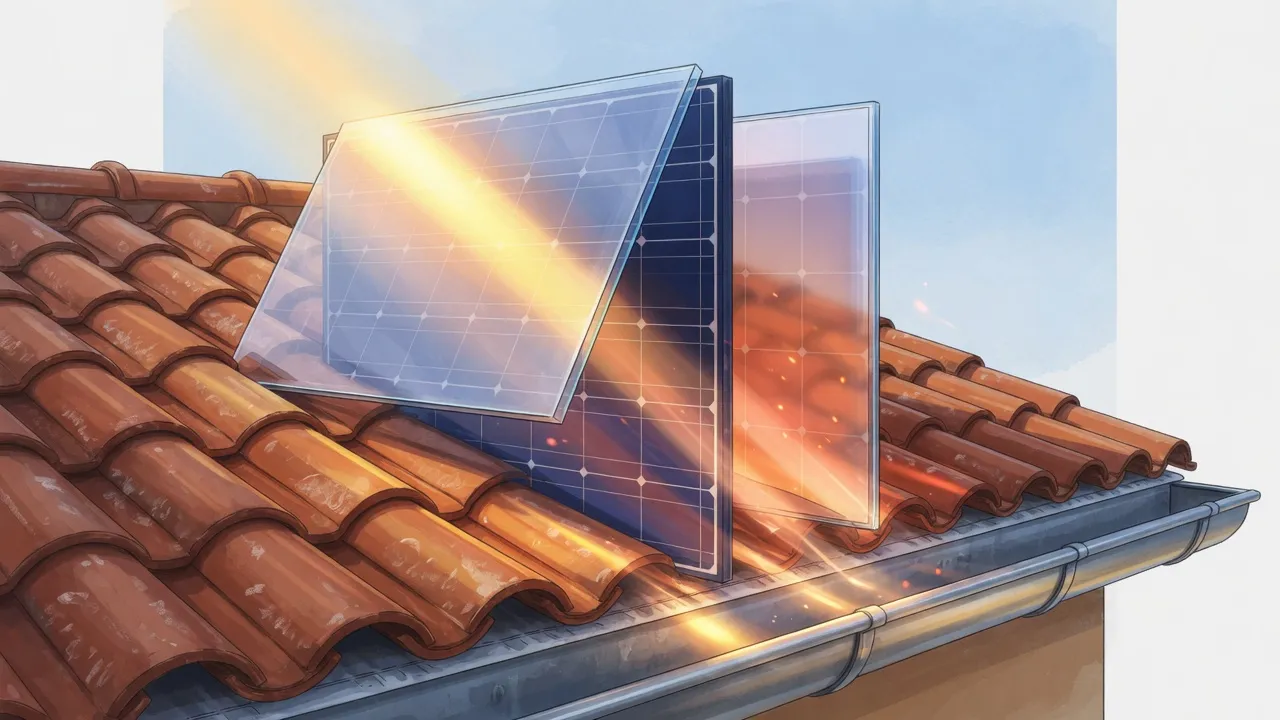
A sunny day: the back does not rest
On a clear day the front takes the lion’s share: the direct beam. Nobody disputes that. What gets disputed, badly, is whether the rear “does anything” when the roof is not white.
It does. Always.
The sun does not hit only the panel. It lights the whole pitch, the zinc gutter, the ridge, the gable wall, the tiles on the other pitch, sometimes a light wall or a courtyard. That light bounces. Some of it comes back to the rear. Some of it comes in through the gap the mounting leaves — on a proper install there are centimetres of air between module and tile, it is not stuck on like a sticker. Through that gap, light enters from the eaves, from the sides and, if there is more than one row, from the aisle between rows.
Add what the neighbouring module reflects, and what the sky still contributes as diffuse light even with the sun overhead: on a clear day, around 20 % of the radiation reaching the ground is not the direct beam, it is sky. That share also sees the back of the module.
On a good day: the front produces like a first-rate panel, and the rear adds a small, constant extra, every sunny day of the next thirty years. It is not a miracle. It is physics. And it is free from minute one, because the panel is already bifacial.
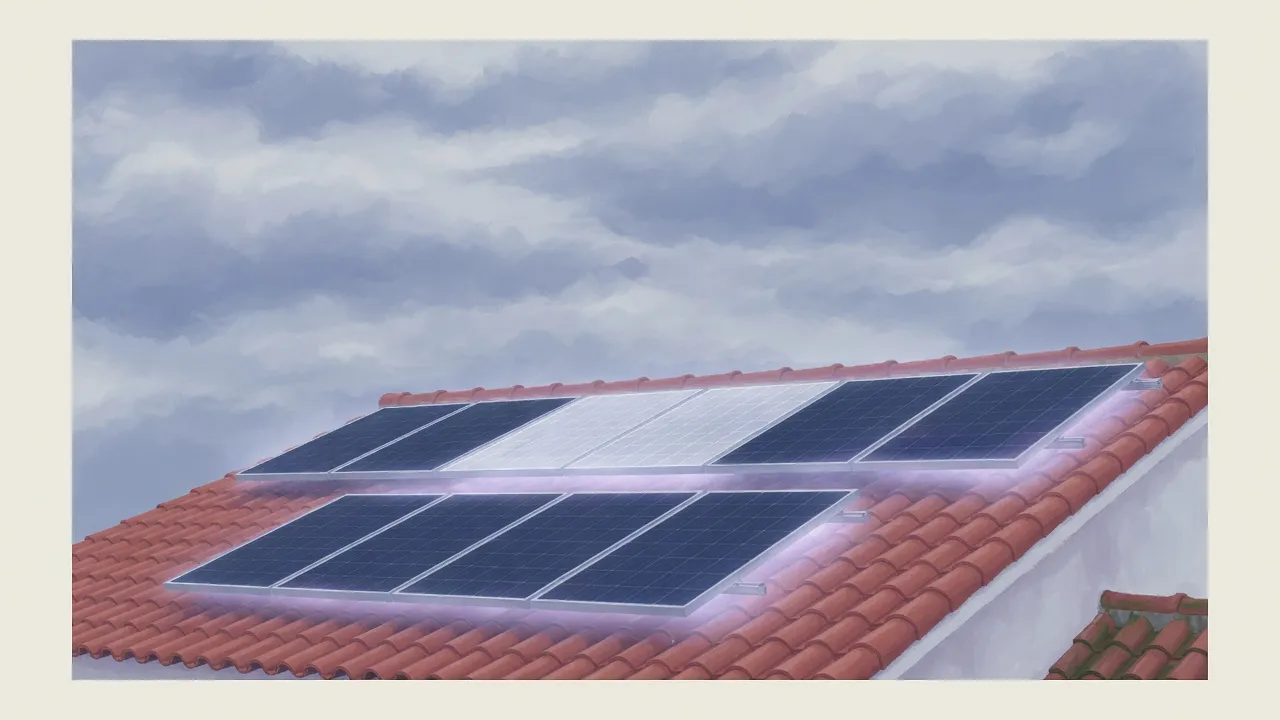
A cloudy day: this is where bifacial shows more, not less
The prejudice is: “if there is no sun, the type of panel does not matter”. The opposite.
Under overcast sky the direct beam disappears. Almost all the radiation that arrives is diffuse light: light that has bounced a thousand times in the clouds and comes from the whole hemisphere, not from a point. Clouds are not a blackout. They are a huge diffuser, and they also reflect a large share of light downwards (cloud albedo is high: on the order of 50 to 80 %).
In that scenario:
- the front keeps working, because silicon does not need a beam: light is enough;
- the rear gains relative weight, because almost everything is now diffuse, and diffuse light arrives from more directions — including from behind, through the edges and the gap;
- the bifacial extra, measured as a percentage of what the panel produces, rises on grey days. Manufacturer and field data put that relative gain around 10–15 % under overcast, versus a smaller extra on a clear day.
The nuance matters: a cloudy day produces fewer kilowatt-hours in absolute terms. Nobody disputes that. What is disputed, and won, is who loses less. The bifacial loses less. And on exactly those days — winter, a storm, a grey morning — every extra kilowatt-hour displaces grid electricity that is usually more expensive. It is not picnic weather. It is the day when the missing saving actually hurts.
There is a second reason, and this one is no longer the rear face: the cell in a current bifacial is n-type TOPCon. It responds better in low light than the p-type PERC still circulating in leftover monofacials. Meaning: even if you taped over the back, the 2026 panel beats the one from four years ago on a cloudy day. Nobody is selling you “the same panel with a sheet of glass behind it”. They are selling you another generation.
Sunny day
+2 to 8%
Direct beam on the front. A small, constant bounce from tile, gutter and gap.
Cloudy day
+10 to 15%
Almost all light is diffuse. The rear gains relative weight. Bifacial loses less.
“But my roof is red tiles”
This is the sentence we hear most often, and it is the worst reason to choose badly.
Red tile is not a black hole. It is terracotta. To the eye it looks dark because the human eye looks mainly at green. The silicon cell looks at something else: red and near infrared. Right there, clay tile reflects more than it “looks”. Visual albedo of a dark tile is often quoted at 10 %. The albedo that matters to the panel is higher. It is not a white membrane. It is not asphalt either.
And the roof is not only the tile:
- there is a gutter, often zinc or aluminium, which reflects;
- there is a ridge, mortar, flashings, sometimes a light chimney;
- there are walls and pitches that see each other;
- there is sky at the eaves and the sides, every day of the year.
The panel is not sitting on an infinite red sheet. It is a few centimetres above a real roof, in a real village, with a real surroundings. That surroundings is not zero.
Even if we granted the worst case — dark tile, little gap, a single row, rear gain of 2 or 3 % — the bifacial still wins. Let’s make the number small, on purpose, so there is no trick.
A typical home with 12 panels (~5.4 kWp) on Spain’s east coast produces around 8,000 kWh a year. A 3 % extra is 240 kWh. At €0.15/kWh of bill avoided, €36 in the first year. The “saving” of fitting monofacial, at €4 a panel, is €48 once. That gap eats itself in a little over a year. You still have twenty-nine years of extra kilowatt-hours. And that is without counting that glass–glass degrades less each year, so the gap grows, it does not shrink.
The monofacial “saving”
€48
€4 × 12 panels. Once. A month of coffee.
The bifacial extra
€36
in year one, at 3% extra. Twenty-nine years still to go.
If your roof were white, the extra would be larger. If it is red, the extra is smaller. In both cases bifacial is the right decision. The tile does not choose the panel. A thirty-year horizon does.
Three or four euros, thirty years, a third of a life
Now the money argument, because it is the only one left when the tile argument falls.
On the current market you no longer find non-bifacial panels as a living product. Serious production lines — JA, Jinko, Trina, LONGi, Canadian and the rest of the first tier — make n-type cells, which are bifacial from the start. The “monofacial” that still shows up on a delivery note is, almost always, one of these three things:
- Old stock of p-type PERC, with worse yield, worse degradation and a plastic sheet.
- A bifacial with an opaque backsheet glued on to sell it as “aesthetic” or to clear a series. You have covered the rear on purpose.
- A white-label module, with a cell the serious market no longer wants.
The saving, when it exists, is around €3 or €4 per panel. On a twelve-module system, €36 to €48. On a twenty-module one, €60 to €80. That is a month of coffee, not an engineering decision.
A photovoltaic system is not an appliance. It is built for more than thirty years. Thirty years is a little more than a third of an average human life. You are choosing the engine of a third of your adult life — and of whoever inherits the house — to save the equivalent of a dinner. It is ridiculous. There is no politer word that is still true.
You do not swap the panel after five years because a prettier one came out. It stays. Every tenth of a percent of yield, every tenth less of degradation, every cloudy day the rear pushes, is collected for decades. Anyone selling you the monofacial “because on red tiles it makes no difference” is not optimising your roof. They are clearing what is left in the warehouse.
And there is a market fact that makes the debate ridiculous all by itself: in 2026 bifacial is not even systematically more expensive. On European listings this year, bifacial TOPCon has traded below monofacial TOPCon, because it is the volume product. You are arguing over a few cents on a good that will work for more than ten thousand days.
What does change (and it is not the colour of the tile)
If you want to squeeze the bifacial, there are real levers. None of them is “change the tiles”:
- Air gap between module and roof: a well-resolved structure lets light through at the back. Sticking the module to the tiles is what kills the rear, not the colour of the tile.
- Rows and edges: modules at the eaves and sides see more sky from behind. On a residential pitch that is not negligible.
- Dirt and shading: a bifacial that is dirty or shaded at the back (a pipe, a cable across it, a work boot left behind) loses what you are paying for. Design and install matter more than the catalogue.
- The cell: n-type TOPCon or 2026 equivalent, not leftover PERC.
None of those levers justifies going back to monofacial. They justify doing the bifacial properly.
The question to ask of the quote
If you are comparing offers, do not ask “is it bifacial?”. Ask this:
- Is the module n-type, glass–glass, a current-catalogue bifacial — not a leftover from 2022?
- What 30-year production warranty does it carry, and at what annual degradation?
- If you put a monofacial on the quote, how much do I actually save, panel by panel, and which cell is it?
- Does the structure leave a real gap under the module, or does it sit almost on the tile?
If the answer to the third is “about four euros” — or silence — you already know which quote to throw away.
In one sentence
Bifacial is not an extra for white roofs or solar farms. It is the panel that exists. It produces more on a sunny day, loses less on a cloudy day, lasts better for three decades and costs the same or almost the same. Red tiles do not disprove it. Three euros do not either.
Choose the panel that will work for a third of a life, not the one that clears the warehouse this week.
→ Request your no-obligation study · or write to us on WhatsApp · 692 22 97 13