A properly built solar installation is not a promise that nothing will ever happen. It is a promise that on day 1 everything is where it should be. But a photovoltaic plant is not “a gadget”: it is panels, strings, DC fuses, protective devices, an inverter, a communications dongle, WiFi, cabling, mounting structure, sometimes optimisers or a battery, the meter and the electricity grid itself. Dozens of parts working out in the open, with heat, damp, storms and years ahead of them. Over time you get wear, protective devices tripping, blown fuses, new shade that was not there before, grid outages or a router whose password has changed. That is not bad workmanship: it is physics and it is time.
What can be promised —and this is what really tells one company apart from another— is not “zero faults”. It is catching them early. And that is where the problem lies: a good share of the faults on a solar installation are practically undetectable if all you do is look at the electricity bill or open the manufacturer's app now and then. A dead string leaves the plant apparently alive: it carries on producing, the inverter stays green, the app does not shout. It is just that you are generating with half your panels. The customer sees “it is still working” and is not alarmed; the fault quietly eats years of savings. Without comparing the theoretical output your plant is due for its location, climate and contracted power against the actual output it delivers, and without reading voltages string by string, that fault shows up nowhere at all.
At Atodosol we have built our own monitoring and after-sales technology for exactly that: to see what you cannot see, resolve it —even as guided self-service where that is safe— and, when a fault on the installation has cost production, measure it and compensate it in a documented way.
What actually breaks
We are not talking about disasters. We are talking about everyday things:
- A blown DC fuse: a whole branch of panels stops contributing.
- A protective device tripping after a storm or a momentary grid outage.
- A dead string caused by a connection that has given way with the heat and cold cycles.
- New shade: a tree that has grown, a neighbour's chimney, an aerial.
- The WiFi or the dongle down: the plant may carry on producing, but it disappears off the radar.
- Damp, rodents, third parties interfering during other building work at the house.
None of these sets off an alarm in your living room. Almost none of them shows up on the bill until many months later, when it is already too late to recover those kWh.
How we see it
We connect our customers' plants to our monitoring platform and read the data from the manufacturers' portals —we run a multi-brand fleet, including Huawei FusionSolar and Solarman/Deye—. We do not keep a “loose screenshot”: we keep the actual daily energy of each plant, which is what builds a serious production history.
On top of that history we work out a health status per plant (green, amber or red) with specific, explainable reasons:
- Dead string or DC fuse: the voltage on that line drops to zero or to abnormal values while the rest of the plant is working normally.
- The plant produces as if it were missing panels: we estimate that from voltage, not from “it was cloudy today”. If your contract says 12 panels and the voltages only add up to half of them, that is a red light even if the inverter is still online.
- Current anomalies in strings, reverse currents and behaviour that does not add up.
- Loss of telemetry: if we stop receiving reliable data, that is an incident too.
- AC protection alarms —grid outages, RCDs— handled separately from DC fuses, because the fix is a different one.
When the fault is severe and sustained, a technical service ticket is opened automatically. We do not wait for the customer to ring up angry eighteen months later. Put briefly: we do not wait for the annual bill to come in; we look at strings, voltages and output day by day.
What we do when one comes up
It depends on the case, and that is precisely the advantage of having the data before you move:
- Remote diagnosis when the data is enough to resolve it or to rule things out.
- A site visit when someone has to go up on the roof or open the consumer unit.
- Guided self-service when it is safe and the case qualifies. If the diagnosis points to a DC fuse, we send the right kit with clear instructions; the customer carries out the replacement following the guide and our system then checks that the plant is back to normal before the incident is closed. If what has gone down is the WiFi, we send a secure link and guide the reconnection step by step.
Self-service is not “sort it out yourself”. It is the opposite: it is only offered in defined, safe situations, with our materials and our guide, and with verification afterwards from the platform. The best after-sales service is not sending a van out for everything. It is knowing when the van is needed and when the customer can get their plant back in half an hour with the right part.
And if kWh have already been lost, then what?
This is where a lot of companies look the other way. We measure it.
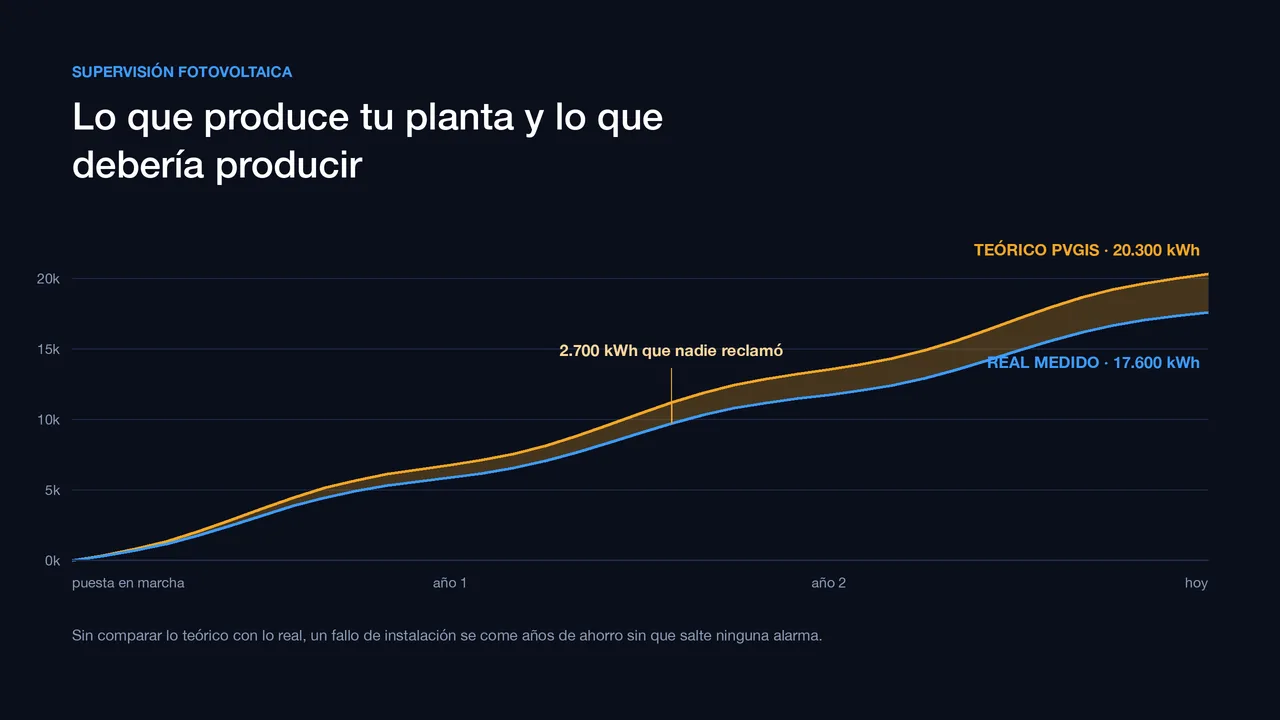
When a fault on the installation has taken output away, we define the affected period, calculate the theoretical output that plant was due —using PVGIS, the European solar radiation database, applied to the location, the installed capacity and the actual orientation and tilt of each roof plane— and compare it with the actual output recorded over the same period. The difference is the loss, and that loss is given a value in money. From there there are two ways out: a documented cash refund to the customer, or compensation in materials —fitting optimisers at no cost, for example— when physically improving the plant is a better remedy than money. Everything is traced: a proposal with the theoretical-versus-actual breakdown, and an accounting record of the compensation. It is not “here is €50 off and let's say no more about it”.
Two real examples from our fleet, anonymised:
A house in Hondón de las Nieves (Alicante). An installation of around ten panels, running since September 2023. The history showed performance consistently below what could be expected, little by little, with no symptom the owner could see. When the analysis was closed: around 20,300 theoretical kWh against some 17,600 kWh actually produced in almost three years. A difference of about 2,700 kWh that nobody would ever have claimed, because nobody knew it existed. The case was closed with compensation in materials: two optimisers fitted at no cost, no bank transfer and no argument. The customer did not lose those kWh into thin air: they got them back in the shape of a better plant for the years still to come.
A plant in Orba (Alicante). Twelve panels contracted, an inverter of around 5 kW, everything “online” and apparently correct on the portal. Our voltage-based estimate said otherwise: the plant was working as if it had slightly fewer than six panels, around 49% of what had been contracted. A technical service ticket was opened for severe underperformance, we intervened, and the output lost along the way was compensated to the owner with €200. This is exactly what a company that does not read strings will never ring you up to tell you: the portal does not shout, the plant “works”, and you are paying for half your investment in the shape of kWh that never arrive.
Years later, out of warranty, or if you sell the house
Two common situations that usually end in a “sorry, it is out of warranty now”.
The first: the passing of time. The classic commercial warranty comes to an end; the faults do not. The difference is that we carry on seeing the plant's data, so we can act —a repair, a kit, a commercial proposal or compensation— instead of hanging up the phone. The warranty window closing does not mean the radar switches off.
The second: a change of owner. If the home is sold or the electricity supply changes hands, what we monitor is still the same asset: the plant, the house, the roof. We reassign the contact when the time comes and look after the new owner. We do not wipe an installation off our radar because a name on a contract has changed.
To be honest about what this is and what it is not: this is an active policy of monitoring and documented compensation where the case justifies it, not an endless legal guarantee of automatic refunds for any kWh at all. Every case is studied and explained with the numbers on the table.
Before you sign with anyone, ask this
- Who looks at my plant after the third month?
- Do you detect a dead string without me calling?
- Do you hold a history of the actual kWh from my installation, or just “online/offline”?
- If a fuse blows, is there a kit and instructions, or just a quote for a call-out?
- If I have lost production because of a fault on the installation, do you quantify it and compensate it?
- If I sell the house, do you carry on monitoring the plant and looking after the new owner?
Six uncomfortable questions, and very cheap to ask. The answers separate the company that sells you an installation from the one that stays with you for twenty-five years.
Let's talk
If you are comparing quotes, compare what happens on day 400 as well, not just on installation day. Tell us about your case and we will tell you exactly what we watch on your plant, how we alert you and what happens if something fails —in or out of warranty—. No obligation, and if your installation already exists and was done by another company, we will look at that one too.
Choose whoever will watch over your plant for its whole working life, not just whoever puts it up in a day.
→ Request your free, no-obligation study · or message us on WhatsApp · 692 22 97 13