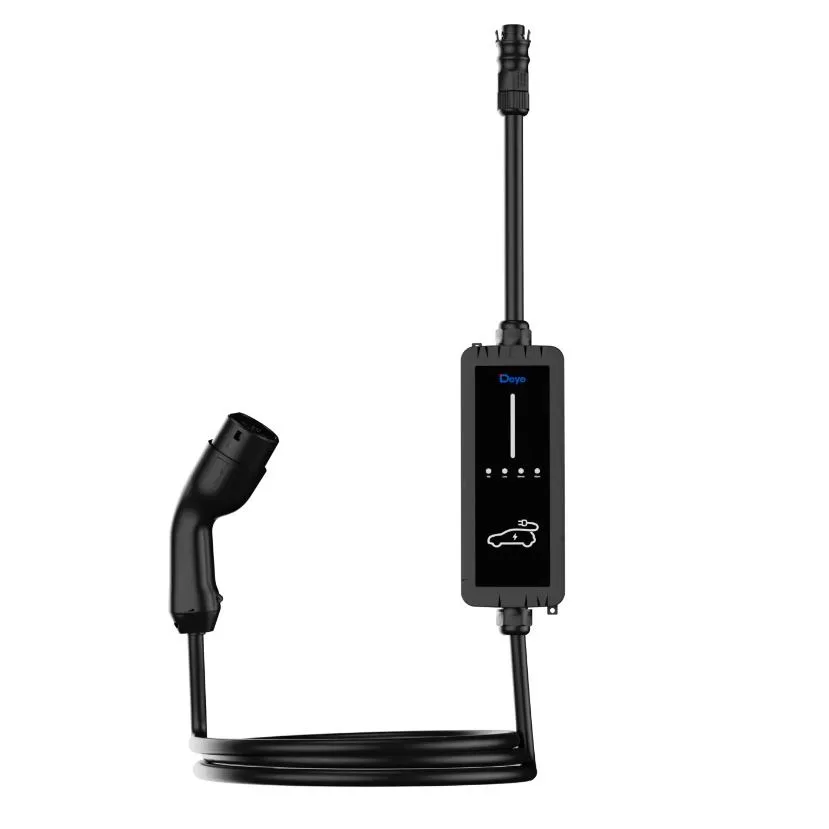
We have put the Deye SUN-EVSE22K01-EU-AC charger (EVSE 7/22 kW) on sale. On paper it is exactly what we wanted after cutting V2C Trydan: integration with Deye inverters, LoRa, solar modes, power management. In practice, part of that promise is still green — especially what matters most in a Spanish home: not tripping contracted power, and actually charging from surplus.
This is not an article to “kill” the product. It is transparency. We prefer to say it ourselves before a customer discovers, with the car plugged in and the breaker about to trip, that automatic Peak Shaving is not operational yet.
What the Deye EVSE promises (and why we put it in the catalogue)
Unlike a “dumb” wallbox, this charger is sold as an energy-management system:
- communication with Deye inverters (LoRa / transmitter),
- charge modes and time schedules,
- charging from solar / surplus,
- automatic power limits,
- operating priorities.
After V2C — field failures plus a SAT that threw the installer under the bus — we wanted something aligned with the ecosystem we already install (Deye inverters and batteries) and dynamic charging that did not depend on home Wi‑Fi as the only crutch. The Deye EVSE fitted that story.
The problem is not the story. It is the firmware.
What is still green right now (July 2026)
It is a recently launched product. Firmware on both the charger and some inverters is still evolving. The technical channel has documented this clearly. Summary of what actually hits the end customer:
1. Peak Shaving / contracted-power adjustment: not yet
This is the bomb. In Spain, with tight contracted powers (3.45 kW, 4.6 kW, 5.75 kW…), a 7 kW or 11 kW charger without dynamic limiting is a recipe for tripping the main breaker or eating the maximum-demand meter.
In the current firmware, automatic charge-power adjustment via Peak Shaving is not available yet. Translation without marketing: the system does not adapt by itself to contracted / available power to avoid exceeding it.
You can — and for now that is the sensible path — set a manual maximum in the app and use it as a classic “smart” charger. But that is not the promise of “I adapt alone to the rest of the house”. That is a fixed ceiling. If you turn on the oven, the water heater and the AC, the fixed ceiling will not save you.
If they sell you “dynamic charging that respects contracted power” and Peak Shaving is not operational, they are selling you the future of the firmware, not the present of the product.
2. “Solar only” / surplus mode: serious limitations
Solar-only mode has limitations, especially on installations without a battery. Today it is not always possible to charge the vehicle using only PV surplus.
That hurts especially for the typical A Todo Sol customer: panels on the roof, sometimes no battery yet, a car that wants to “charge from the sun”. If solar mode does not close the loop, you end up charging from the grid… or not charging because the mode is active and there is not “enough” surplus under the current firmware logic.
3. Inverter compatibility: case by case
Not every Deye inverter talks properly to the charger. Older models can show communication problems. Some may be fixed by a future firmware; others still have no official compatibility confirmation.
Practical consequence: you cannot promise universal compatibility in advance. You must check the specific model, sometimes ask Deye for an inverter firmware update, and not invent miracles on the quote.
4. LoRa, RS485 and the real installation “gotcha”
On some inverters — especially older ones — you need an external USB adapter to power the LoRa antenna supplied with the charger, because the inverter itself does not provide enough power. Another “detail” of a new product that becomes an extra visit, extra materials and an explanation to the customer.
And here is the only serious gotcha with this charger, beyond green firmware: on Deye inverter models that have a single RS485 port already taken by battery communication, the system will require external power (and brings far more complexity than expected: cabling, adapters, failure points, commissioning time). This is not a quote checkbox: it is a communication design that collides with real installs where the battery already “ate” the only RS485.
If your inverter has that bottleneck, tell us beforehand. We prefer to say it in the offer rather than discover it on install day with the car parked and the customer watching the clock.
5. Mode complexity: the car “won’t charge” and it is not broken
Schedules, modes, priorities… A vehicle may not start charging simply because a schedule is active or because it is in Solar-only with no surplus. The unit is not dead: it is obeying logic the user does not understand.
That is not “the customer is stupid”. It is a product that demands a pilot’s manual when many people only want to plug in and sleep.
Firmware on the way (what Deye told us)
Deye’s team told us they are working on firmware improvements precisely for these functions (Peak Shaving / available-power adjustment, solar modes, integration). It matters for both the inverter and the charger: flashing only the EVSE is not enough; the brain of the system is the pair.
That does not make green mature today. But it changes the tone: this is not an abandoned product — it is one the manufacturer half-admits and says it is fixing. We will follow the firmware; when Peak Shaving and Solar-only truly close in the field, we will say so here — not in a marketing PDF.
What does work (important, so we do not lie the other way)
These limitations do not stop the charger from charging the car.
- It can run autonomously over Wi‑Fi even if it does not talk to the inverter.
- From the app you can set a manual maximum power.
- As a configurable wallbox, it delivers. As a mature “energy brain” with Peak Shaving and Solar-only done right, not yet.
There is also an installation rule that matters: do not connect it to the inverter’s Backup/EPS (Load) output, to avoid overloads in backup. The connection point matters. Commissioning is not “hang it and done”.
This is not the same problem as V2C Trydan
Do not mix fights. With Trydan we stopped new installs because of repeated field failures (protections, board connectors) and a SAT/channel that used the installer as a fuse. With the Deye EVSE the diagnosis is different:
- V2C: product that burned our reputation + toxic support → out of new builds.
- Deye EVSE: new product with advanced features announced but incomplete firmware → we sell it with the truth up front, without selling Peak Shaving as if it already existed.
The shared lesson is the one in how brand SAT can break a brand: marketing cannot run three firmwares ahead of the hardware. Whoever does that leaves the installer alone with the customer’s disappointment.
What we do at A Todo Sol (clear rule)
- We tell you before you sign. If your case needs millimetre-perfect contracted-power fighting or living on Solar-only without a battery, today this charger may not be the best tool — or it must be configured with manual ceilings and realistic expectations.
- We check inverter compatibility before promising LoRa integration / advanced modes.
- We do not connect to Backup/EPS as a shortcut. Correct connection point or it is not done.
- Serious commissioning: firmware, LoRa, app, tests. This is not a DIY wallbox. If the channel needs remote support and configuration time, we plan it; we do not hide it in fine print.
- We follow the firmware. When Peak Shaving and Solar-only truly mature, we will update our criteria and, if needed, this article.
We prefer to lose an easy sale than install a “dynamic charge” that does not charge dynamically yet.
Who it makes sense for today (and who it does not)
It makes sense today if you accept using it as a smart charger with a manual limit, want the Deye ecosystem for the future, and understand that the “wow” features (automatic Peak Shaving, fine Solar-only without a battery) may arrive later via firmware.
It does not make sense today if your only reason to buy is “it should drop automatically when the house draws power” or “it should only charge from surplus without a battery” and there is no plan B. In that case we would be selling a roadmap, not a feature.
Conclusion
The Deye SUN-EVSE22K01-EU-AC is not vapourware: it charges, it configures, it can live without the inverter. But it reached the market with its brain half-flashed. Peak Shaving tied to contracted power: not available (Deye says firmware is on the way, for inverter and charger). Solar-only / surplus: limited, worse without a battery. Compatibility: case by case. And the site gotcha: inverter with a single RS485 taken by the battery → external power and extra complexity.
At A Todo Sol it is in the catalogue with our eyes open. If we offer it to you, it will be with this paragraph on the table — not under the quote.
Questions about your contracted power, your Deye inverter or whether you should wait for more mature firmware? Talk to us or see the chargers we install. Coming from the Trydan mess, the product cut is here: we stopped installing V2C Trydan.