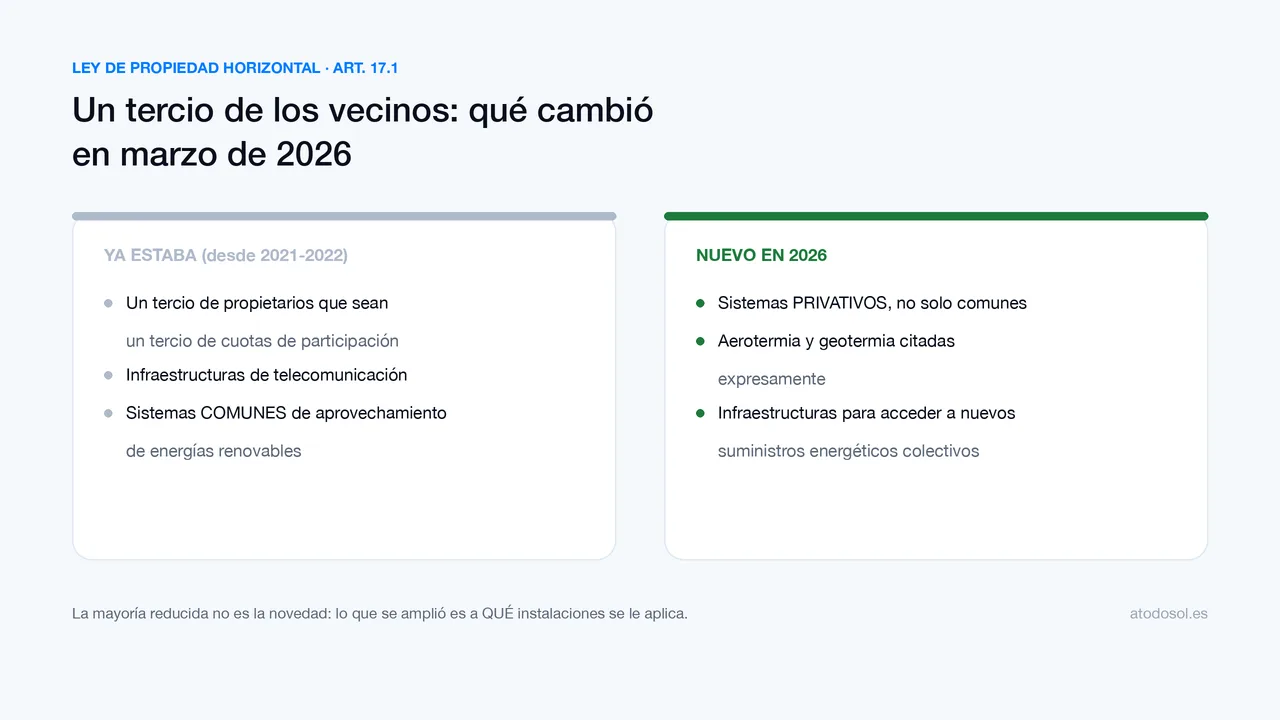
If you have read over recent months that “a third of the homeowners' association is now enough to put solar panels up”, you have been told half the story. That one-third majority is not new: it has been in the Ley de Propiedad Horizontal (Spain's Horizontal Property Act, the law governing blocks of flats) for years. What changed on 21/03/2026, when Royal Decree-law 7/2026 (RDL 7/2026) was published in the BOE (the Spanish official gazette), is something else —quieter and, depending on your case, a good deal more useful to you—.
We have read the text of the law, not the press release. This is what it says, small print included.
What the Horizontal Property Act says today
Article 17.1 now reads as follows:
“The installation of common infrastructure for access to telecommunications services […], or the adaptation of existing infrastructure, as well as the installation of common or privately owned systems for harnessing renewable energy, including aerothermal and geothermal energy, or of the infrastructure needed to access new collective energy supplies, may be agreed, at the request of any owner, by one third of the members of the association, who in turn represent one third of the participation quotas.”
The lowered qualified majority —one third of the owners, who between them also hold one third of the shares in the building— was already there for common systems for harnessing renewable energy. What 2026 added is three things:
- Privately owned systems, not just common ones.
- Aerothermal and geothermal energy (air-source and ground-source heat pumps), named explicitly.
- The infrastructure needed to access new collective energy supplies.
Why “privately owned” is the change that matters
Picture the most common case in a block of flats: one owner wants panels for their own flat, not a system shared by the whole association. The kit is theirs, the output is theirs, the bill that goes down is theirs. But they need to use a common element —the roof— and to run cabling through common areas.
Until March the wording talked about “common systems”, and that is where the argument began: what majority do you need in order to authorise a private installation on everybody's roof? Every managing agent had their own view and every general meeting had its row. Now the article itself covers the case: a privately owned renewable energy installation, agreed at the request of any owner with that one third and one third.
That said, and without selling you smoke: this is not a blank cheque. It is still a resolution of the general meeting, it has to be called and recorded in the minutes, the statutes still have to be respected, you must not damage common elements or occupy the roof in a way that prevents others from using it, and it is worth putting in writing who maintains what and what happens if that owner sells the flat. The law hands you the majority; it does not save you from doing things properly.
The other change: from 2 to 5 kilometres
The same royal decree-law amended Royal Decree 244/2019, the one that regulates self-consumption. An installation is still considered nearby if it is less than 500 metres away, and this case has been added:
“A generation installation using photovoltaic or wind technology with a capacity of up to 5 MW shall also be considered a production installation near to the consumption points and associated through the grid, where it is connected to the consumer or consumers through transmission or distribution lines and provided that these are at a distance of less than 5,000 metres from the associated consumers. For this purpose, the distance shall be taken between the metering equipment, in their orthogonal projection on plan.”
Three details worth keeping in mind: the distance is measured between the metering equipment and as a projection on a plan —it is not the distance your sat-nav gives you by road—; the capacity limit is 5 MW; and the technology has to be photovoltaic or wind.
If that particular scenario is of interest to you —two nearby homes sharing one installation— we cover it in full in Shared self-consumption between two homes within 5 km.
The small print almost nobody mentions
The same reform rewrote section 5 of article 4 of RD 244/2019, and there are three rules in there that shape things quite a bit in practice:
- You cannot be under two self-consumption arrangements at once. The only exception allowed is combining individual self-consumption without surplus with self-consumption from nearby installations connected through the grid.
- Where self-consumption is through the grid, it must necessarily be with surplus.
- Under collective self-consumption, if the arrangement is changed, the change has to be made by all participating consumers at the same time. A single one cannot switch to another arrangement on their own.
That last rule is the one that tends to surprise an association: joining a collective share-out is a group decision, and so is leaving it or changing it.
The “self-consumption manager”
The Spanish Electricity Sector Act (Ley del Sector Eléctrico) introduces a new figure. The legal definition is short:
“Self-consumption managers, being the natural or legal persons who represent the interests of the consumers associated with a self-consumption arrangement, by authorisation from those consumers, carrying out in their name the steps necessary for its proper operation.”
In other words: someone the participants authorise to handle the paperwork on their behalf —the admin for a shared self-consumption scheme with six neighbours and three different electricity retailers is exactly why so many projects never get past the chat in the bar—.
Let's be honest about what does not exist yet: the figure has been created in the law, but the implementing regulations, if they come, will arrive by ministerial order. Today it is a framework, not a settled procedure. Anyone promising you that “your self-consumption manager sorts everything out” is running ahead of the BOE.
And the tax part, which expires this year
The same royal decree-law created a deduction in IRPF (Spanish personal income tax) for installations carried out between 01/01/2026 and 31/12/2026:
- 10% of what you pay if you install on a property you own. It can include storage systems.
- 20% for owners of homes in predominantly residential buildings where the installation has been carried out during that period.
- Maximum base: €5,000 per year. The same installation does not give entitlement to both deductions at once.
And the conditions that make a lot of people lose it without realising:
- You have to pay by card, bank transfer, nominative cheque or deposit into an account. Anything paid in cash does not qualify, no exceptions.
- Public grants received, or awarded by final resolution, are deducted from the base.
- The deduction is applied in the tax year in which the installation is completed, which cannot be later than 2026.
- You have to hold the authorisations and permits, in particular the Certificado de Instalaciones Eléctricas (CIE, the Spanish electrical installation certificate).
- It does not apply if the installation is assigned to a business activity; and if you assign it later, you lose the deduction already claimed.
We are not tax advisers and this is not advice: it is what the BOE says, summarised. Your gestoría (the accountant who files your tax) has the last word on your return.
What we would do if you lived in a block of flats
- Look at the roof first, not at the law. Usable area, orientation, shade from the lift housing, where the cabling would run down to your consumer unit. If the roof is not up to it, a one-third majority is not much use to you.
- Decide privately owned or collective. Your own installation on the common roof is not the same thing as a share-out between several neighbours with coefficients. The second option spreads the cost, but also the paperwork and the agreements.
- Take a project to the meeting, not an idea. With capacity, location, cable route, maintenance and who pays for what. Agreements fall apart over what was never written down.
- Close the paperwork within 2026 if you want the deduction: the installation has to be finished this year, with its CIE.
If you are at that point, we will study it for you and tell you straight whether your roof works or not —including when the answer is that it is not worth it—.
Request your free, no-obligation study · or message us on WhatsApp · 692 22 97 13
Sources: Real Decreto-ley 7/2026, of 20/03/2026 (BOE no. 71, of 21/03/2026); Ley 49/1960, on horizontal property, article 17.1 as currently worded; Real Decreto 244/2019, articles 3 and 4, following the amendment made by the fourteenth final provision of that royal decree-law.