Two homes under 5 km apart, one good roof, and a wish to “share the sun”. In Spain that sentence hides two different mechanisms: collective self-consumption through the grid (real hourly kWh split by the DSO) and retailer compensation / virtual battery (euro credit on a bill). Mix them up and you will think you are “sending power to the neighbour” when you are only selling cheap surplus and using a commercial wallet.
This article covers how shared PV between two dwellings works, who chooses the sharing coefficients (spoiler: the customers), i-DE / Iberdrola paperwork, how a host battery changes the deal, and when collective beats virtual battery.
| Collective self-consumption ≤5 km | Virtual battery / retail compensation | |
|---|---|---|
| What moves | Hourly kWh (β + CAU) | Euros / bill credit |
| Who sets the split | The customers (signed sharing agreement) | The retailer (product T&Cs) |
| Who runs the books | DSO (e.g. i-DE) | Retailer |
| 5 km rule | Legal proximity matters | Not the criterion of the virtual product |
1. What shared self-consumption between two homes is
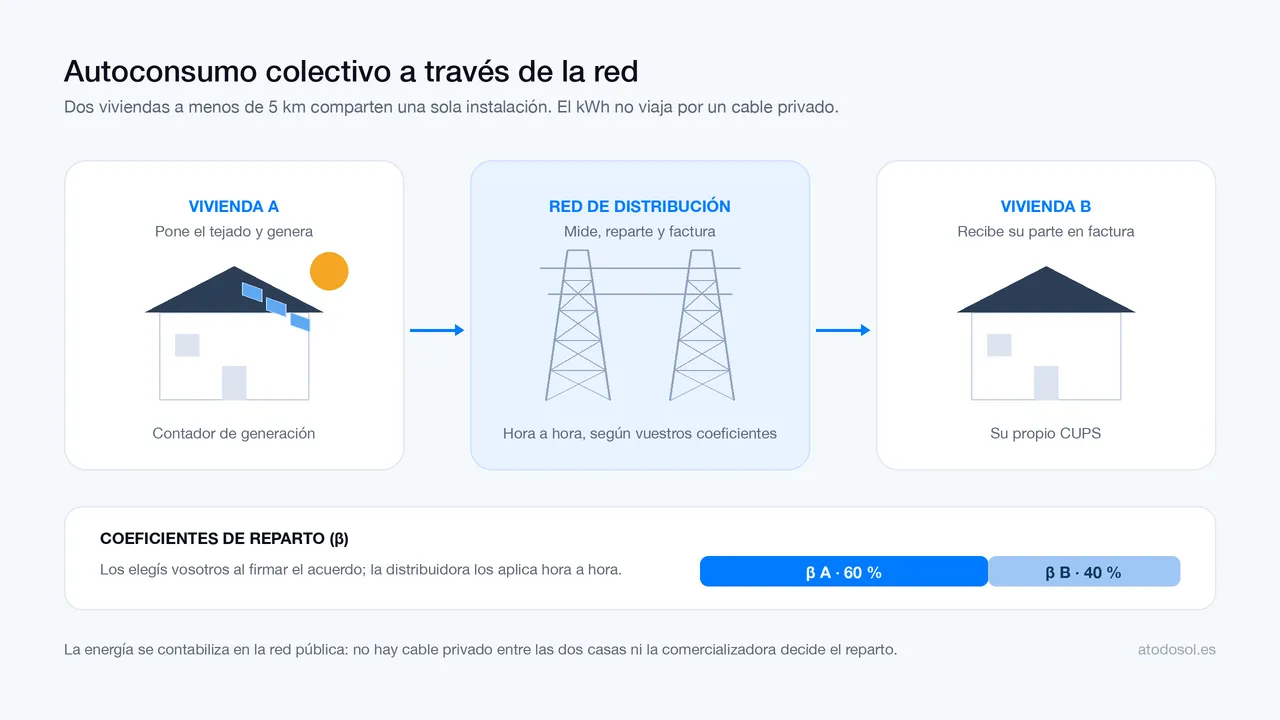
Royal Decree 244/2019 lets associated consumers split net generation with β coefficients. Two CUPS are enough. Through-the-grid collective self-consumption means the public network intermediates; the DSO allocates kWh using the percentages you filed — not a private cable and not a retailer whim.
Vignette 1 · Two CUPS, one roof
Parents + adult child 3 km away
Good roof on parents’ house (A). Child (B) has a flat with no useful roof. They choose collective self-consumption and β 65 % / 35 %. i-DE and the retailer do not invent 65/35 — the customers do, sign it, and send the coefficient file. Next year they can move to 50/50 the same way.
| Situation | Collective through the grid? | Multi-CUPS virtual battery? |
|---|---|---|
| Homes 1.2 km apart, roof on one | Yes if proximity rules fit | Optional for residual surplus |
| Homes 4.5 km (5 km case applies) | Yes, with legal check | Optional |
| Home + second home 80 km away | No | Yes if the product allows |
RDL 7/2026 pushed proximity up to 5 km for eligible plants up to 5 MW (roofs, industrial land, certain artificial structures).
2. β coefficients: the customer chooses (not Iberdrola, not i-DE)
| Actor | Chooses β? | Real job |
|---|---|---|
| Customers (CUPS holders) | YES — decide and sign | Sharing agreement, %, later changes |
| Installer / self-consumption manager | No (advises only) | Simulate loads, draft papers, .txt file, push the file |
| i-DE (DSO) | No | Validate format, apply β, activate |
| Iberdrola or other retailer | No (for regulated split) | Contract update, surplus compensation / virtual battery |
| Home A (70%) | Home B (30%) | |
|---|---|---|
| Assigned generation (10 kWh hour) | 7 kWh | 3 kWh |
| Load that hour | 5 kWh | 4 kWh |
| Self-consumed from share | 5 kWh | 3 kWh |
| Surplus of share | 2 kWh (A’s) | 0 |
| Grid import | 0 | 1 kWh |
Vignette 2 · “Will Iberdrola set 50/50?”
No.
Retail Iberdrola does not allocate collective kWh. i-DE allocates using the file that came from your agreement. If you signed 80/20 because A paid 80% of the plant, bills follow 80/20 — even if a call-centre agent says “normally it is half and half”.
Vignette 3 · Three legal splits, same plant
| Your criterion | Example β | When it fits |
|---|---|---|
| Who paid for the build | 80% / 20% | A financed almost everything |
| Measured daytime load | 55% / 45% | Maximise self-consumption for both |
| Family “fair split” | 50% / 50% | Similar money in and similar loads |
All three are legal if they sum to 100% and are signed. Legal means yours.
3. Bureaucracy checklist
| # | Step | Who owns it? |
|---|---|---|
| 1 | Private deal: money, maintenance, insurance, sale of the home | Customers |
| 2 | Choose β and sign the sharing agreement | Customers |
| 3 | Design + licensed install | Installer |
| 4 | CAU | Installer / manager + DSO |
| 5 | Access & connection / collective file | Installer ↔ DSO |
| 6 | Regional legalisation (CIE) | Installer |
| 7 | CAU_YYYY.txt coefficient file | Manager from what you signed |
| 8 | DSO notice + each supply contract update | Manager / retailers |
| 9 | Optional surplus compensation / virtual battery | Each customer + retailer |
| Phase | Typical time |
|---|---|
| Physical install | Days to a few weeks |
| Legalisation + collective activation (i-DE area) | Often 2–6 months |
| Changing β later | New agreement + file + activation window |

Vignette 4 · Classic stall
Roof produces; B’s bill does not care
Usually a bad .txt, missing signature, or regional notice not yet at the DSO. Calling the retail light call centre does not move an i-DE collective file.
4. “Iberdrola” bureaucracy: retailer vs distributor
| i-DE (DSO) | Iberdrola or other retailer | |
|---|---|---|
| Role | Metering, CAU, file, apply your β, activation date | Contract update, billing, compensation / virtual battery |
| Chooses coefficients? | No | No |
| Typical stalls | Bad .txt, incomplete signatures, missing regional notice | Activation not received yet; confuses collective with surplus product |

5. Collective ≤5 km vs virtual battery
| Regulated collective | Virtual battery / retail compensation | |
|---|---|---|
| Object | Hourly kWh per CUPS | € balance from surplus value |
| Who sets the split | Customers (β) | Retailer T&Cs |
| Key papers | Sharing agreement + CAU + .txt | Commercial product enrolment |
| Distance | Legal proximity | Whatever the product allows |
| Replaces the other? | — | No — may only top up residual surplus |
Vignette 5 · Same family, two products
Collective for the nearby flat; virtual for the coast house
A and B at 2 km → collective with customer-chosen 60/40. A’s house 200 km away is outside the CAU; at most, residual surplus of A feeds a retailer virtual battery. Two mechanisms, two logics.
6. Physical battery at the host home
| Setup | Midday flow | Who benefits more |
|---|---|---|
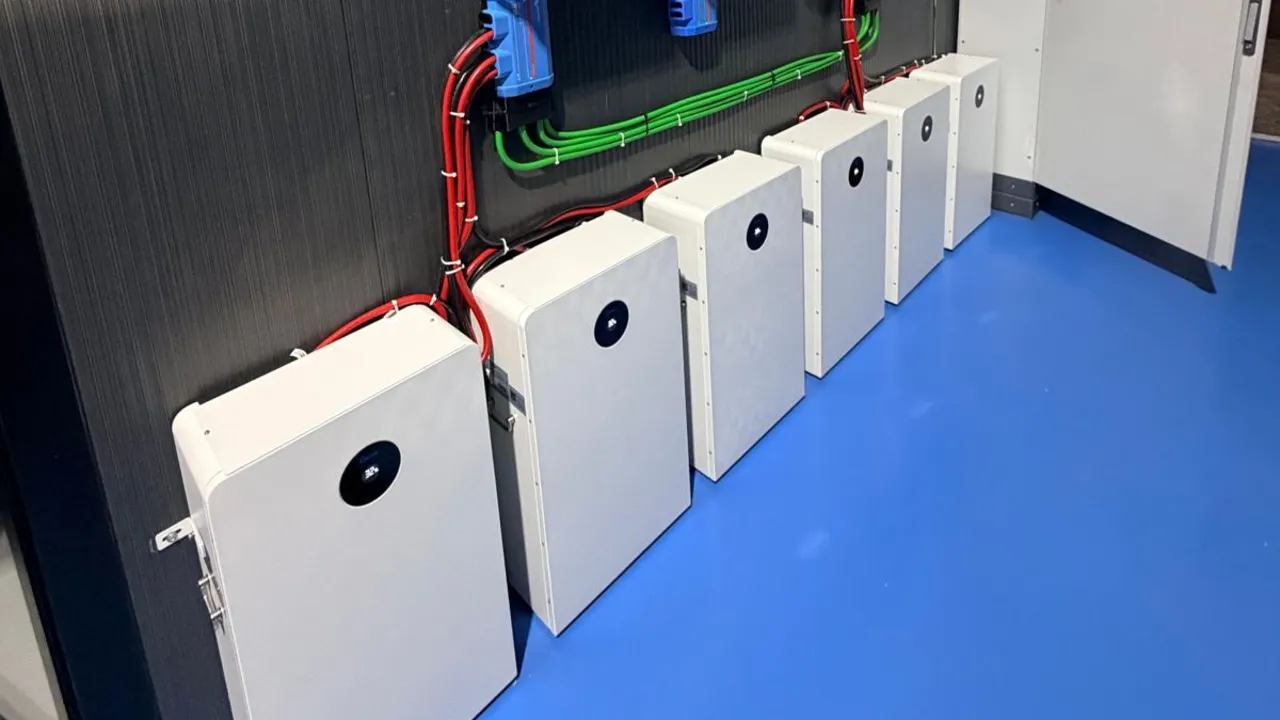
| Battery at A | PV → A load → A battery → remainder becomes shareable net generation | A |
| Battery at B | B charges from its β share + grid only | B only if β and load allow |
| Storage in collective perimeter | Discharge shared by β if metering is correct | Per agreement — serious engineering |
Vignette 6 · The “selfish” battery
50/50 on paper, crumbs for B
You signed 50/50, but A’s large battery charged all morning. Shareable net generation collapsed. The paper split did not break — the bottle was emptied before pouring. Simulate β with the battery; adjust capacity or β. Again: customer decision.
7. Is it profitable?
| kWh type | Indicative value (2026) |
|---|---|
| Self-consumed (avoided import) | Often about €0.15–0.30/kWh |
| Surplus to compensation / virtual | Often only a few cents |
| Scenario | Collective usually worth it? |
|---|---|
| Great roof on A, none on B, <5 km, daytime loads both | Yes |
| Same owner, two CUPS, deliberate β | Yes |
| B empty all day | Doubtful |
| Huge battery on A, token β for B | No for B |
| Virtual sold as “5 km collective” | Read the contract |
Vignette 7 · Brochure vs reality
“Zero bill on both homes”
With good β and no selfish battery you can cut both bills a lot. Guaranteed dual zero without hourly curves is sales fiction, not engineering.
8. Recommended sequence
| Step | Action | Decision owner |
|---|---|---|
| 1 | Hourly load curves A and B | Customers + installer |
| 2 | Check distance / proximity case | Installer |
| 3 | Choose β with and without host battery | Customers |
| 4 | Private cost / exit contract | Customers |
| 5 | Build + legalise | Installer |
| 6 | Agreement + file until both bills show self-consumption | Manager (your signature) |
| 7 | Only then: residual compensation / virtual | Each customer + retailer |
9. FAQ
| Question | Short answer |
|---|---|
| Who chooses coefficients? | Customers / CUPS holders in the sharing agreement. |
| Can Iberdrola or i-DE impose them? | No. They apply them; they do not decide them. |
| Same owner, two homes? | Yes — cleanest case. |
| Same retailer mandatory? | Not for the regulated split; practical yes. |
| Does virtual battery replace 5 km collective? | No. |
| Is 50/50 the legal default? | Legal is whatever you sign summing to 100%. |
Conclusion
Sharing PV between two homes within 5 km is real. The core is hourly kWh allocation by the DSO using coefficients you choose and sign — not a retail “solar community” slogan. A host battery prioritises the host unless engineered otherwise. Virtual battery is a surplus wallet: useful, secondary, easy to confuse with collective self-consumption. At A Todo Sol we simulate curves, propose β options — you decide — and push the DSO file until both bills tell the truth.
Reference: RD 244/2019, Order TED/1247/2021, IDAE collective guides, i-DE procedures, proximity expansion under RDL 7/2026. Rules change — verify at activation date. Informational only; not a substitute for a technical project or legal advice.