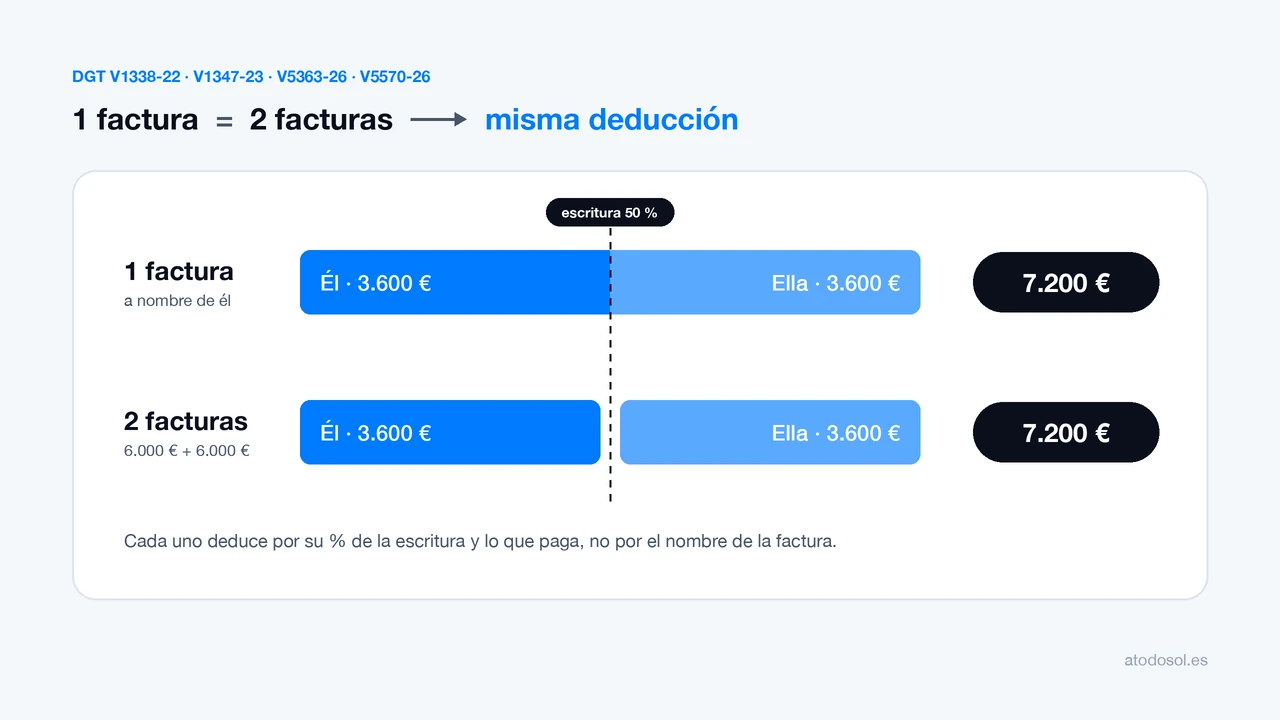
We are asked this a lot when people sign, always with good intentions: “Can you put half the invoice in my name and half in my wife’s? That way we both get the deduction.” The short answer: if you both own the house and you both pay, you already both deduct with a single invoice. And if you don’t, splitting it won’t get you there. This is not our opinion. The Spanish tax authority has answered it in writing, in binding rulings, at least nine times between 2022 and September 2026.
Why people ask (and why it makes sense)
Behind the request there is almost always one of these four ideas:
- Fear of losing half: “if the invoice is only in his name, I won’t be able to deduct”.
- Doubling the cap: “the maximum base is €5,000; with two invoices we get two caps”.
- Loading it onto whoever pays more income tax: “put most of it in my name, she earns little”.
- Counting the spouse who is not on the deeds: “the house was mine before we married, but we both paid for the panels”.
All four are reasonable. None of them is solved by the invoice.
What the tax agency looks at: the deeds and the bank
The national income-tax deductions for solar — the 20, 40 and 60% of the 50th additional provision of the Income Tax Act — are shared out using two documents, and neither of them is the invoice:
- The deeds (or land-registry extract): what percentage of the home belongs to each of you.
- The bank statement: who paid and from which account. By transfer, card, nominative cheque or paying-in. Cash never deducts.
The Directorate-General for Taxes (DGT) says it with the same sentence, ruling after ruling. The latest we have found, V5570-26, is dated 16 September 2026:
“Each co-owner of the home may take the deduction for the amounts they have paid for the works, in the part that proportionally corresponds to their percentage of ownership of the home, regardless of whether the invoice for the works was issued solely in the name of one of the co-owners.”
The same paragraph appears in V1338-22, V2031-24, V0970-26, V5322-26 and V5363-26. And the DGT adds how it is proved: by any means valid in law (articles 105 onwards of the General Tax Act), with the final assessment left to the tax agency. In plain words: deeds, statements and invoice have to tell the same story.
The four real-life cases
| Your situation | Who deducts | Does splitting the invoice change anything? |
|---|---|---|
| Community property, house owned 50/50, paid from the joint account | Both of you, 50% each, even if the invoice carries one name (V5322-26, V5363-26) | No. You already have it with one. |
| Separate property, house 50/50, one spouse pays everything with their own money | The one who pays, but only on their 50%. The other half goes undeducted (V5570-26, V0970-26) | No. Putting half the invoice in the name of someone who didn’t pay does not create a payment. |
| House owned by one spouse only (inherited, or bought before the marriage) | Only the owner, even if you both pay (V0472-23, V2412-23) | No. The invoice does not make the other spouse an owner. |
| House 50/50 and you want to load 70% onto the higher taxpayer | Each of you, at most, by your percentage on the deeds | No. If the tax agency checks, the extra 20% is clawed back with interest. |
Separate property is where the only real lever is: if you want to use both halves, each of you pays your share from your own account. That does change the deduction. The name on the invoice does not.
And the €5,000 cap? It is already per person
The “two invoices, two caps” idea starts from a mistake: the cap is already per person. The DGT said so in V1347-23 and repeated it in V5363-26: if you file separately, the €5,000 annual base and the €15,000 accumulated base of the 60% apply in each return, on what each of you paid according to your share of ownership.
What does change the cap is a joint return: there the limits are not multiplied (article 84.2 of the Income Tax Act) and the €5,000 a year is for both of you. In exchange, there is a single tax bill. If one of you pays hardly any income tax, that is the decision to run the numbers on. And it is made in the tax return, not on the invoice.
An example with round numbers. A €12,000 installation on your main home, house owned 50/50, community property, paid from the joint account, an energy certificate that qualifies for the 60%, and separate returns:
| How it is invoiced | Him | Her | Total |
|---|---|---|---|
| One invoice in his name | €3,600 | €3,600 | €7,200 |
| Two invoices of €6,000 | €3,600 | €3,600 | €7,200 |
| €8,400 to him and €3,600 to her | €3,600 (anything claimed above that is clawed back) | €3,600 | €7,200 plus a problem |
Each of you paid €6,000: €5,000 goes in the year of the certificate (€3,000 of deduction) and the remaining €1,000 the following year (€600). Provided each of you has enough income tax to absorb it: what doesn’t fit in one spouse’s return cannot be used by the other, whoever’s name is on the invoice.
The 2026 10% deduction (62nd additional provision) also talks about a property “that you own” and amounts paid. We have not yet seen a ruling on married couples, but nothing suggests the invoice will weigh more there than the deeds and the bank.
In the Valencian Community, the 40% regional deduction doesn’t double either
The Valencian deduction for self-consumption (40% on your main home, with the system entered in the self-consumption register) has its own rules, and they point the same way. According to the tax agency’s 2025 income-tax practical manual:
- the maximum base is €8,800 per home and year, for all the taxpayers of that home together;
- if there are several of you, that limit is shared out according to what each of you actually paid;
- and you don’t need to own the property.
In other words: two invoices don’t turn €8,800 into €17,600, and what shares out the limit is the payment, not the name on the paper. In a house owned by one spouse, the non-owner can take it too, but only for what they actually paid.
Why it is not just useless: it backfires
- It opens an inconsistency you will have to explain. If the invoice says 50/50, the bank says one of you paid and the deeds say something else, any tax enquiry starts right there. A single invoice, paid from the joint account of a house owned 50/50, is explained in one line.
- One installation is not two half-installations. There is one inverter, one roof, one electrical installation certificate (CIE), one entry in the self-consumption register and one surplus contract with the retailer. For a single transaction with several recipients, the Invoicing Regulation provides for a single original and, if needed, duplicates showing each person’s share (article 14 of Royal Decree 1619/2012, which the DGT recalls in V3024-18). Two “half” invoices for the same job do not describe it as it is.
- If the split isn’t the real one, the excess deduction is paid back. With late-payment interest and, if the tax agency finds fault, a penalty. In the 60%, the unused base carries forward up to four years: so does the mistake.
- VAT doesn’t change. If the job qualifies for 10% VAT as a home renovation, the 40% materials limit is measured on the whole transaction, not on each half-invoice. We explain it in 10% or 21% VAT.
- Correcting it takes time. Changing later whose name is on each invoice means issuing corrective invoices. And the 10% deduction requires paying and installing within 2026: time is exactly what you don’t have.
Outside the tax agency, everything is in one person’s name
Solar panels don’t only live in your tax return. Around the installation there is a chain of paperwork, and every link carries a single name:
- The CUPS, the code that identifies your electricity supply point, has one holder: whoever holds the electricity contract.
- The electricity bill goes to that holder, and that is where the surplus is credited. There is no half electricity bill for each of you.
- The distribution company registers the self-consumption on that CUPS and that holder.
- The regional Industry department legalises the installation, with its electrical installation certificate (CIE), in one holder’s name.
- The town hall processes the works licence or notice and any local tax rebates with a single applicant.
With one invoice, all those papers tell the same story. With two, the solar invoice is the only document with two names, and it is exactly the one that doesn’t match any of the others.
Why A Todo Sol no longer splits invoices
Because we did it once. A customer asked us and we did them the “favour” of splitting the invoice between the two spouses. What came next you can’t imagine: trouble with the town hall, with the Industry department, with the tax agency, with the distribution company and with quite a few more. The invoice said two names; everything else said one.
Since then, A Todo Sol doesn’t split invoices. And we’ll say it without qualification: don’t split yours. Our job is to make sure the deduction arrives, not to make the invoice symmetrical. Splitting it doesn’t get you a single extra euro and opens the only door through which it can be lost: papers that don’t match. What we recommend:
- One invoice, in the name of whoever signs the contract. If you both own the house, it doesn’t matter which of you: each deducts their share.
- Pay through the bank, never in cash. With community property, from the joint account. With separate property, if you both want to deduct, each pays their share from their own account.
- Keep the full kit: deeds or land-registry extract, proof of payment, invoice, energy certificate before and after (for the 40 or 60%), CIE (for the 2026 10%) and the self-consumption register entry (for the Valencian 40%).
- Run the numbers on separate versus joint returns. That is where the cap and the tax bill that absorbs the deduction actually change.
What we will not tell you
- That splitting the invoice “doubles the deduction”. The €5,000 cap is already per person if you file separately.
- That the spouse who isn’t an owner takes the 60% “because they’re on the invoice”. The DGT says the opposite.
- That paying cash is fine “as long as the invoice is right”. Cash doesn’t deduct, whatever name is on it.
We are not your tax adviser: your return is decided and signed by whoever files it. If your case falls outside these four — a house in three names, a usufruct, a divorce in progress — you can request your own binding ruling from the DGT; it is free. What we do is install, legalise and hand you, on time, the paperwork the deductions require.
→ Request your no-obligation study · WhatsApp 692 22 97 13 · 40% or 60%
Sources: DGT binding rulings V1338-22 (13/06/2022), V0472-23 (01/03/2023), V1347-23 (22/05/2023), V2412-23 (07/09/2023), V2031-24 (23/09/2024), V0970-26 (29/04/2026), V5322-26 and V5363-26 (28/07/2026), V5570-26 (16/09/2026) and, on invoicing, V3024-18 (23/11/2018); 50th and 62nd additional provisions and article 84.2 of Income Tax Act 35/2006; article 105 of the General Tax Act; article 14 of Royal Decree 1619/2012; AEAT 2025 income-tax practical manual (Valencian deduction for self-consumption installations). General information as of 21/10/2026. It does not replace your tax adviser or a DGT ruling on your case.