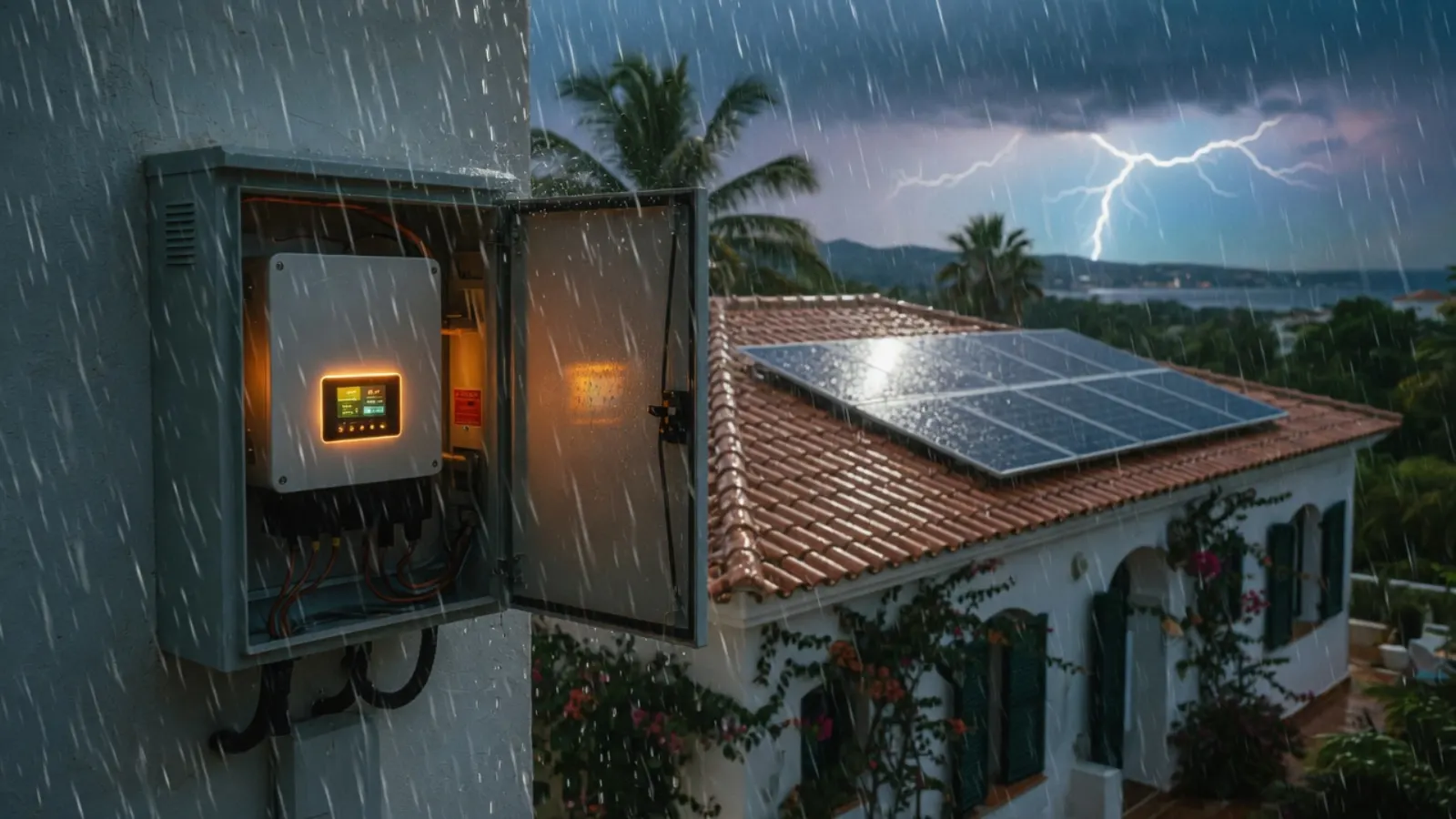
Regulation · hybrids · TT earthing
Low-voltage rules still treat two products as if they were one: a grid-tied inverter that injects on an extra circuit, and a hybrid that is the house. The first fits ITC-BT-40. The second does not. Homes pay twice: when it rains, a GRID RCD that will not reset; when the grid drops, a floating neutral more than a hundred volts from earth.
What ITC-BT-40 draws
A generator connected to the indoor installation on an independent dedicated circuit, with a Type A 30 mA RCD in dwellings. The house is still fed by the grid. The inverter is one more circuit on the board.
What this house actually is
A hybrid with the whole dwelling on LOAD. GRID is the utility link and, on-grid, the path of the entire house. There is no extra generation circuit. The inverter is the supply of the home.
The circuit the rules draw — and the one that is not there
The second final provision of Royal Decree 244/2019 added a clear duty to ITC-BT-40 §4.3: a self-consumption generator (with surplus, or without surplus above 800 VA) connects to the indoor installation on an independent dedicated circuit, from a board with Type A residual protection, 30 mA in dwellings and residential areas.
That text is written for the classic grid-tied inverter. Panels, inverter, an MCB and an RCD in a sub-board, then onto the house busbar. The dwelling stays the dwelling. Generation is one more circuit. The 30 mA on that circuit watches leakage on the generator cable, not the family in the shower.
A hybrid that backs up the whole house is not that product. It is not «added» to the board. It is inserted. The whole dwelling leaves the LOAD port. The GRID port faces the utility. On-grid, house current goes through the inverter. There is no generation circuit you can cut out of the single-line diagram without lying.
GRID is not generation. LOAD is not generation.
Three places, three jobs. Folding them into one 30 mA device is where the mess starts.
The error of reading the ITC diagonally
Putting the «generation» 30 mA on the GRID of this hybrid does not match the 2019 drawing: it turns the supply of the whole house into a generation RCD. It sits in series with the dwelling 30 mA devices. Guía BT-17 gives no selectivity. And that device sees a residual that is not a leaking toaster: it is the plot earth talking to the utility neutral.
When it rains, the earth talks to the distributor’s neutral
Spanish homes are TT. The utility neutral is referenced at the transformer. The house rod is another earth. On paper they do not meet. In the field they do: wet soil, nearby rods, an N–PE jumper the house already had in an old board. It is not a fault you «find» on a dry commissioning day. It appears when the ground conducts.
With the grid present the hybrid internally ties LOAD N to GRID N. If at that moment there is a path between the rod and the utility neutral, part of the house current stops returning on the RCD’s copper and comes back through the soil. The GRID RCD compares line and neutral. It sees a real 50 Hz residual. It trips.
It is not a «fussy» RCD. It is doing its job on a path the dwelling does not control. The customer resets. The ground is still wet. The house is still drawing load. It trips again. After several tries, many reclosers lock. The house goes dark when the battery is empty.
- 01The house draws amps. The line leaves through the GRID RCD toward the inverter and the loads.
- 02With the rod coupled, part of the return leaves through earth and does not pass the RCD’s neutral.
- 03The RCD opens. It is reset. The earth path is still there. It opens again. The battery is not infinite.
That is a serious nuisance and a supply risk: fridge, pump, medical devices, remote work. It is not an installer’s footnote. It is what happens in the south-east when a cold drop soaks the ground for days. The rules have no figure for this coupling. They still talk about a dedicated generation circuit as if the house were not on the other side of the same machine.

The problem many installers underestimate: a floating neutral in island
The other side of the same architecture is worse, and it shows less on commissioning day. When the grid drops, the hybrid opens the GRID relays and makes line and neutral from the battery. If nobody references that neutral to earth only in island, LOAD N floats.
The lights stay on. A meter between line and neutral still reads 230 V. The customer says «backup works». From each pole to earth the voltage splits: around 110 V line-to-earth and 110 V neutral-to-earth. ITC-BT-24 limits touch voltage to 50 V dry and 24 V wet. One hundred and ten volts is already out.
A bolted earth fault usually moves enough current and often trips. A person is not a bolted fault. With a floating neutral, the inverter’s Y-capacitors limit body-to-earth current to about 10–25 mA. A dwelling 30 mA RCD does not have to open: it must not trip below 15 mA and must open at 30 mA. Ten or twenty milliamps sit in the gap. The shock is real. The RCD can stay closed.
| State | L–N | L–PE | N–PE |
|---|---|---|---|
| Island with N–PE closed | 230 V | 230 V | ≈ 0 V |
| Island with floating neutral | 230 V | ~110 V | ~110 V |
| Island, first line-to-earth contact | 230 V | ≈ 0 V | ~230 V |
Shower, kitchen, wet floor
The whole house is on LOAD. A grid cut does not kill the heater or the bathroom. If the neutral floats, a tap or a class-I chassis can sit at 110 V to earth, with a body current that never reaches the 30 mA threshold. That is not an app warning. It is a hole in protection at the one moment the family thinks they are «safe on the battery».
IEC 60364-8-82 expects, in island, a TN-like scheme: neutral bonded to earth upstream of the load RCDs. It is not a brand whim. It is so the dwelling 30 mA does the same job it does on-grid. Without that bond, backup turns the house into an improvised IT system with no insulation monitor.
The bond that does belong
The backup neutral is joined to earth in island, and opened when the grid returns. Contactor, internal relay, maker’s pins: the hardware depends on the machine. The rule does not. With the grid present, that bond joins the utility neutral to the customer’s rod. With the grid gone, that bond is what stops the neutral from floating.
What gets left half-done on commissioning day
Backup «looks as if it works» if the lights stay on. A floating neutral does not show if nobody measures line-to-earth and neutral-to-earth in a cut. That is why it is underestimated.
None of those omissions raise an alarm in the app. The inverter is «off-grid». The house has light. The hazard is on the masses, not on the display.
Why a 30 mA on the GRID of this hybrid fights the physics
The ITC asks for 30 mA on a dwelling generation circuit so touch voltage is not dangerous. On a hybrid with the whole house on LOAD, that 30 mA, if it is placed on GRID, is not watching a PV spur: it is watching the whole dwelling toward the utility. Any current that returns on the rod — rain, an old jumper, N–PE overlap on reconnection — is a trip.
The 30 mA RCDs on final circuits remain the dwelling’s people protection. A line-to-person-to-earth contact at a socket is theirs. The GRID RCD does not see that toaster: it sees the link. Asking that link for the same 30 mA as a dedicated circuit is asking it to treat as «generation leakage» an earth coupling that TT does not forbid in the soil and that the hybrid, by architecture, puts in series.
More than one European hybrid maker, if an external GRID RCD is fitted, asks for 300 mA or more because a transformerless unit has Y-cap leakage. The ITC, read as a dwelling rule, still says 30 mA. Two texts, one port, a family in the dark every time the ground conducts.
What an updated ITC should say
There is no need to invent a new code. There is a need for a figure this machine already is, and for two hazards the 2019 text does not name.
- An explicit scheme for the hybrid that feeds the whole dwelling from LOAD: GRID is the network interface, LOAD is the indoor installation. Stop calling the house supply a «generation circuit».
- 30 mA Type A people protection is required on the dwelling final circuits, where contact happens. Not in series on the passthrough of the whole house.
- The backup N–PE bond only in island. On-grid, that bond joins the utility neutral to the rod. The text must say so, not leave it to installer habit.
- Name TT earth–utility-neutral coupling when it rains. A GRID RCD on this hybrid will see it. Treating it as «generation leakage» is not having stood on the plot.
- A commissioning test in island: measure N–PE ≈ 0 V with the bond closed, and L–PE ≈ 230 V. If N–PE sits at 110 V, the installation is not finished, even if the lights come on.
What to ask before signing a hybrid with the whole house on LOAD
This is not a list to scare anyone. It is the difference between backup that is a home and backup that is a sticker.
- When the grid drops, is LOAD N joined to earth? How is that checked on handover day?
- On-grid, is that bond open? If not, the rod is a second neutral.
- If it rains and the GRID RCD trips, can it be reset, or does the house stay off the grid until the ground dries?
- Do the 30 mA devices for bathroom, kitchen and sockets stay on the dwelling circuits, independent of the GRID port?
A Todo Sol fits hybrids with the whole dwelling on LOAD because we want a grid cut not to kill the house. That forces a clear talk about two things ITC-BT-40 still does not draw: the RCD that sees the earth when it rains, and the neutral that floats if nobody references it in island. The first is a nuisance that leaves families in the dark. The second is a hole in protection. Both belong in an update. Neither belongs in a single-line copied from a 2019 grid-tied inverter.
→ WhatsApp 692 22 97 13 · technology · solar PV
ITC-BT-40 §4.3 as amended by the second final provision of RD 244/2019; ITC-BT-08 (TT); ITC-BT-24 (touch voltage); Guía BT-17 (selectivity); IEC 60364-8-82 (backup supplies). A Todo Sol, 11 October 2026.