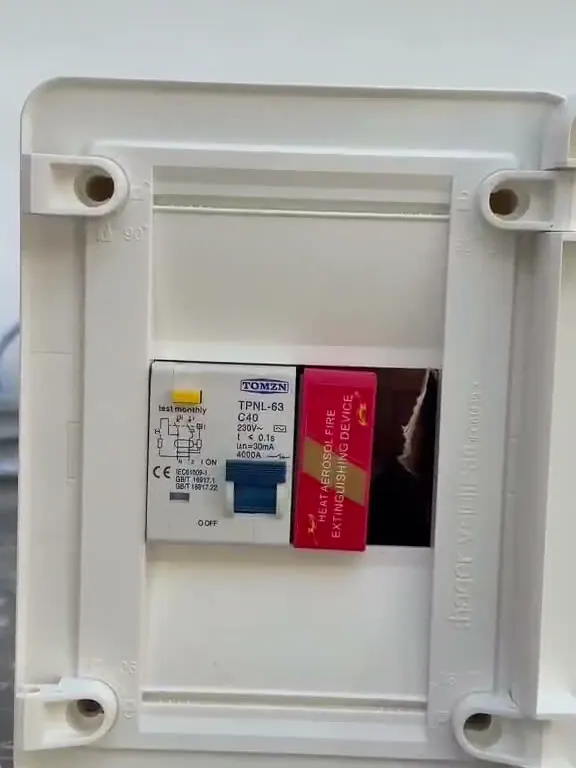
A solar quote usually ends at the breaker. Fuse, RCD, DC isolator. That cuts the current. It does not put out a fire that has already started inside the box: a loose terminal, a connector running hot, an arc. The inverter app does not cover that. SAT arrives afterwards.
That is why, as standard, we put an automatic thermal aerosol extinguisher in the cabinet. A red DIN-rail module, next to the protection devices. When the heat of a fire reaches it, it releases a cloud that interrupts combustion inside the closed enclosure. No battery. No Wi‑Fi. Nothing for you to do. Even if the power is already out.
What it is (and what it is not)
It is a heat-activated condensed-aerosol extinguishing device, made for a closed enclosure: the protection board, the DC string box, the inverter or battery cabinet, the electrical compartment of the EV charger. The unit we fit is labelled Heat Aerosol Fire Extinguishing Device.
It does not replace REBT electrical protection. It does not put out a roof fire or a panel fire. After it has fired, the module has to be replaced. It is the missing layer when the fire has already started inside the box.
We have tested it with a real fire
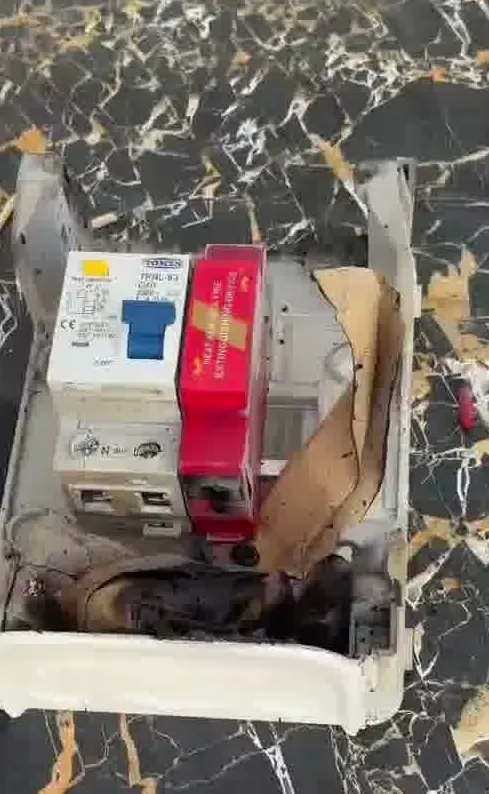
This is not a brochure. We lit fuel inside a closed cabinet, with the module on the rail. Heat fired it. The aerosol filled the enclosure. The flame went out. When we opened it, the inside was dirty with residue — as it should be after a suppression — and the device had done its job.
A second test, with an open flame, shows the intensity of the electrical fire a loose terminal can feed, and the cloud the module throws when the heat arrives. On site the cabinet is closed: that cloud stays inside, which is exactly where it has to work.
Why almost nobody fits it (and why we do)
Most photovoltaic quotes stop at what the regulations require. That is fine. It is the minimum. The minimum does not put out an incipient fire at three in the morning, with the house empty and the Wi‑Fi down.
String monitoring tells you a fuse has blown. The inverter's AFCI tells you it saw an arc. This is something else: if the fire has already started inside the box, the aerosol knocks it down. Detecting is not putting out.
We include it as standard on every installation. It is not an extra. It does not expire. It does not ask for an app.
Where we fit it
- The home or industrial AC protection board
- The DC isolator and string box
- The inverter and battery cabinet
- The electrical compartment of the EV charger
The technical detail is on Technology. If you want to see it in a quote, it is included. Ask the other company whether theirs carries one too.
→ WhatsApp 692 22 97 13 · cabinet fire suppression · solar PV