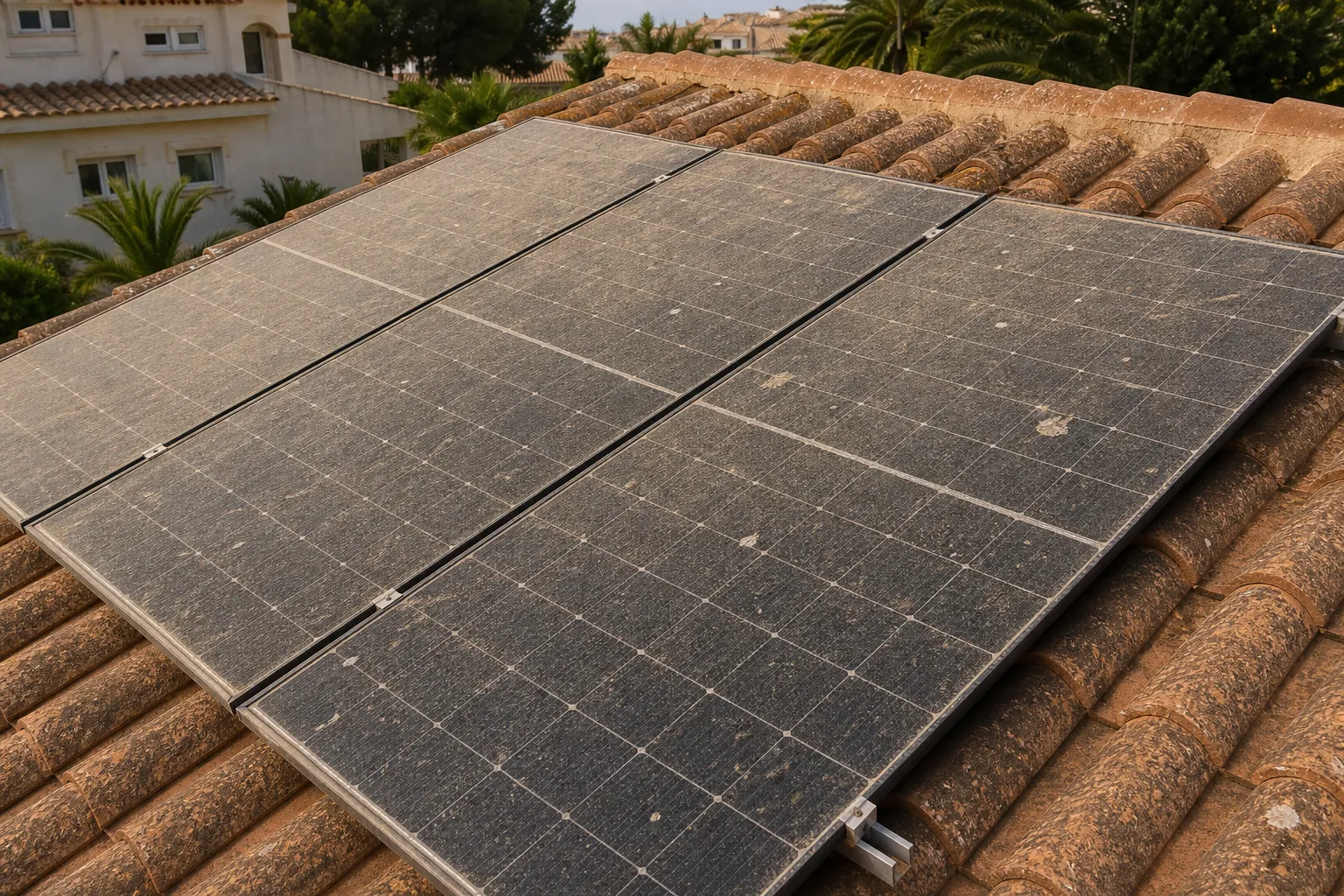
Every summer the same sermon returns: «your panels are dirty, you are losing money, they must be cleaned». Cleaning firms say it, influencers with a hose say it, and sometimes installers who found an extra revenue stream climbing other people’s roofs. Our view, without anaesthetic: on most residential monocrystalline installs in Spain, routine “professional” cleaning does not repay the risk or the cost. And sometimes it does more harm than the dirt itself.
This is not an attack on physics. Soiling exists. Calima (Saharan dust haze) exists. A dusty panel produces less. The question is not “does dirt matter?”. The question is: is it worth climbing the roof (or paying €80+) for a few euros until the next heavy rain? In our opinion, no. According to companies still stuck in the dark ages of the mop pitch, yes.
Monocrystalline: the “urgency” to clean is usually inflated
Modern monocrystalline panels, properly tilted, in Mediterranean or Atlantic climates with real rainfall, largely clean themselves. They are not a glass fridge door in a paint shop. Rain washes fine dust. Wind helps. Average annual soiling loss on many homes is modest — not the 30% apocalypse some leaflets sell.
There are real exceptions (we will not varnish them):
- almost flat roofs where water does not run off,
- zones with constant industrial dust, construction or heavy traffic,
- bird droppings concentrated on one part of a string,
- pollen / dried mud that forms a crust light rain will not move.
Outside those cases, turning cleaning into “mandatory maintenance every X months” is often selling fear with a mop.
The calima trick: ugly to the eye, reset by the first storm
In summer — and especially after a light calima — it is normal for panels to look “filthy”. Fine dust shows. Daytime production can fall on the order of ~15% versus a comparable clean day. That sounds like a lot. Until you look at the calendar:
- that loss is not forever,
- the first heavy rain usually returns the panel to a visually and productively “as new” state in what matters,
- in between, you are talking about a few euros of energy, not the ruin of the system.
That is the business of whoever calls you the Tuesday after a calima: they show the dust photo, talk about “loss”, and send a quote. They do not show Thursday’s photo after the downpour.
If your energy strategy depends on rubbing glass every time there is a calima, you do not have a panel problem. You have a salesperson problem.
Cleaning badly does more harm than leaving the dust
Here is what almost nobody says in the “eco cleaning” advert:
Cold water on a hot panel
The classic summer DIY mistake. Glass and cells are hot under the sun. You arrive with a hose at 15–20 °C. Thermal shock can create microcracks you cannot see with the naked eye… and that degrade module life over time. Not a forum myth: a real thermal risk. So if anyone cleans for real, the sensible window is very early morning or very late evening, without direct sun — not even “cloudy but the panel is still hot” — with the module close to ambient temperature.
Translation: the correct window is inconvenient. The wrong window (midday, full sun, cold water) is the one most people use. And it can cost you more than calima dust.
Abrasive pads, aggressive brushes, “miracle” chemicals
Scratches on the glass, chemical residues, too much pressure… Another way to “improve” today’s output at the expense of the panel five years from now. A quality monocrystalline module lasts decades if you do not abuse it. A macho clean can shorten that story.
Falling off the roof
Not a metaphor. Climbing a pitched roof with a hose, soap and trainers is one of the stupidest ways to “save” €12 of kWh. Fractures, insurance claims, worse. No soiling percentage justifies an accident.
“Professional” cleaning: from €80… and often with a lift
A serious professional clean is not a kid with a bucket. It means:
- travel,
- PPE and insurance,
- demineralised water / proper tools,
- and on many roofs a mobile elevating platform or scaffolding because otherwise you cannot reach safely.
That is why the real ticket often starts around €80 and climbs with difficulty, height, access and module count. Compare that with the energy you “recover” until the next heavy rain in a climate that actually rains several times a year. On too many residential quotes, the cleaning invoice exceeds the value of the dirt it claimed to cure.
And yes: saying this goes against our commercial interest if someone expected A Todo Sol to sell panel-cleaning contracts. We do not sell them as a flagship product precisely because we do not believe that is the best use of your money or our time. We prefer to install well, orient well, monitor for real and not invent a “mop maintenance” line to invoice.
So… never clean?
We did not say that. We said routine cleaning driven by fear or marketing is usually a bad decision. A one-off intervention can make sense when:
- there are crusts, mud or droppings rain will not move,
- you measure (not “look at”) a sustained loss unexplained by weather or shade,
- access is safe or a professional does it with a platform — no cold water at midday.
Even then: cool hours, no sun punishing the glass, no improvisation. And with the million-euro question on the table: how many euros will I recover before it rains again?
What we do watch (and it is not the mop)
If you really worry about “losing production”, calima dust is rarely the silent villain. What does steal kWh without you noticing is a dropped string or a blown fuse: the system stays “on”, the manufacturer’s app often stays quiet… and you produce half.
That is why at A Todo Sol we monitor performance automatically, every day — the same approach we describe on Technology:
- every night we compare each string’s voltage against its commissioning baseline,
- if a fuse blows or a string fails, we find out (we do not wait until it is “visible from the ground”),
- included for life while the inverter is online — without selling you a mop contract.
That does protect your investment. Climbing the roof with cold water at midday does not.
Our position (critical, not superstitious)
Blunt summary, without falsehoods:
- On well-installed residential monocrystalline, the importance of cleaning “often” is low.
- Calima leaves panels looking dirty and can cost on the order of ~15% for a day; heavy rain usually resets the problem.
- Cleaning badly (cold water on a hot panel, unsafe roof work) can do more harm than dust.
- A real professional clean costs money (€80+) and often needs serious access equipment.
- Risking a fall or paying that ticket for a few euros until the next storm usually is not worth it.
Companies anchored in the old script — “dirty = clean now or lose a fortune” — live off that anxiety. We prefer the uncomfortable truth: your panels are not a showroom car. They are outdoor generators. Rain is part of the design. Fear is not.
If you want to maximise production for real, look at shade, dropped strings, failed inverters, orientation and sizing — and let our automatic monitoring alert you when a string fails —. Not the cloth. And if after a calima the roof looks grey, breathe: check the rain radar before you call the lift. More on how we watch strings and fuses: atodosol.es/en/technology.