
Your bill keeps rising
You pay more each year for the same energy. Self-consumption produces power exactly when your machinery needs it.
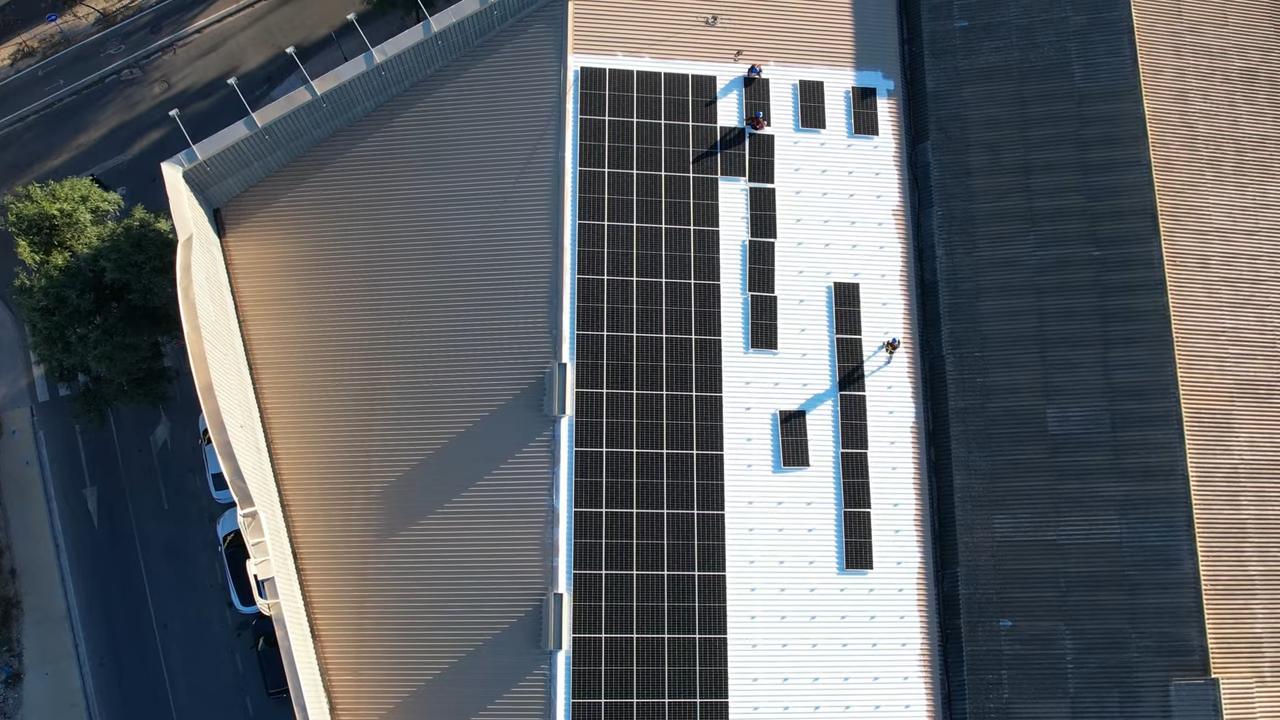
Turn your roof into your company's own power plant.
Cut your electricity bill by up to 70% and protect production.
Solar panels on an industrial building can cut the electricity bill by 40% to 70% because production hours coincide with daylight. With 2,500 to 3,000 hours of sunshine a year in eastern Spain, an industrial system typically pays back in 3 to 6 years and lasts around 30 years.
You pay more each year for the same energy. Self-consumption produces power exactly when your machinery needs it.
Cold storage and production lines cannot wait. Batteries keep selected critical loads running when the grid fails.
Hundreds of unused square metres can generate the energy you now buy from the grid, while the roof and system remain yours.
A business can install solar with no upfront investment through finance or leasing: zero deposit, 5-to-7-year payments supported by bill savings, and ownership from day one. This is the alternative to a 15-year PPA, where a third party owns the system.
| Option | Deposit | You own the system | Best for |
|---|---|---|---|
| Direct purchase | One payment | From day 1 | Businesses seeking maximum savings and tax amortisation. |
| Finance / leasing | €0 | From day 1 | Businesses that do not want to tie up working capital. |
| Free preliminary audit | €0 | Study phase | Any business that wants to see its real figures before deciding. |
Offered a “no-investment” PPA? Before signing, see who keeps the value generated by your roof for 15 years. Understand the real cost of a PPA →
You can also install solar without paying upfront or giving away the system. See financing options →
Peak shaving uses batteries to trim an industrial site's demand peaks. At the highest-consumption moments, the building draws from the battery instead of the grid, reducing maximum-demand penalties and contracted capacity every month.
Industry pays not only for energy but also for maximum power demand. Machinery startup can affect the whole bill. Battery control flattens those peaks automatically and can create room to grow without upgrading the grid connection.
Marcopack in Lorquí, Murcia, uses real-time peak shaving to keep grid demand within its contracted power. See the full case study below.
Four practical advantages over the inverter manufacturer and other installers. The first three watch the plant for life. The fourth puts out a fire in the cabinet even if the power is already out.
Every night we compare each string against commissioning day. If a fuse blows while the system remains online, we detect the lost production.
We alert you if the external grid has been absent for more than 24 hours, even when backup has kept the building running.
We install and support at weekends to avoid interrupting weekday production.
A thermal aerosol module on the DIN rail. It fires on heat, needs no power and no internet, and puts out an electrical fire inside the box. Almost no solar company includes it as standard.
The manufacturer app shows production. We make sure the system does not fail in silence — and that a fire in the cabinet does not reach the building.
We publish only real industrial installations and confirmed figures. Marcopack, in Lorquí (Murcia), combines inverters, battery storage and peak shaving so production runs at 100% without raising contracted power.
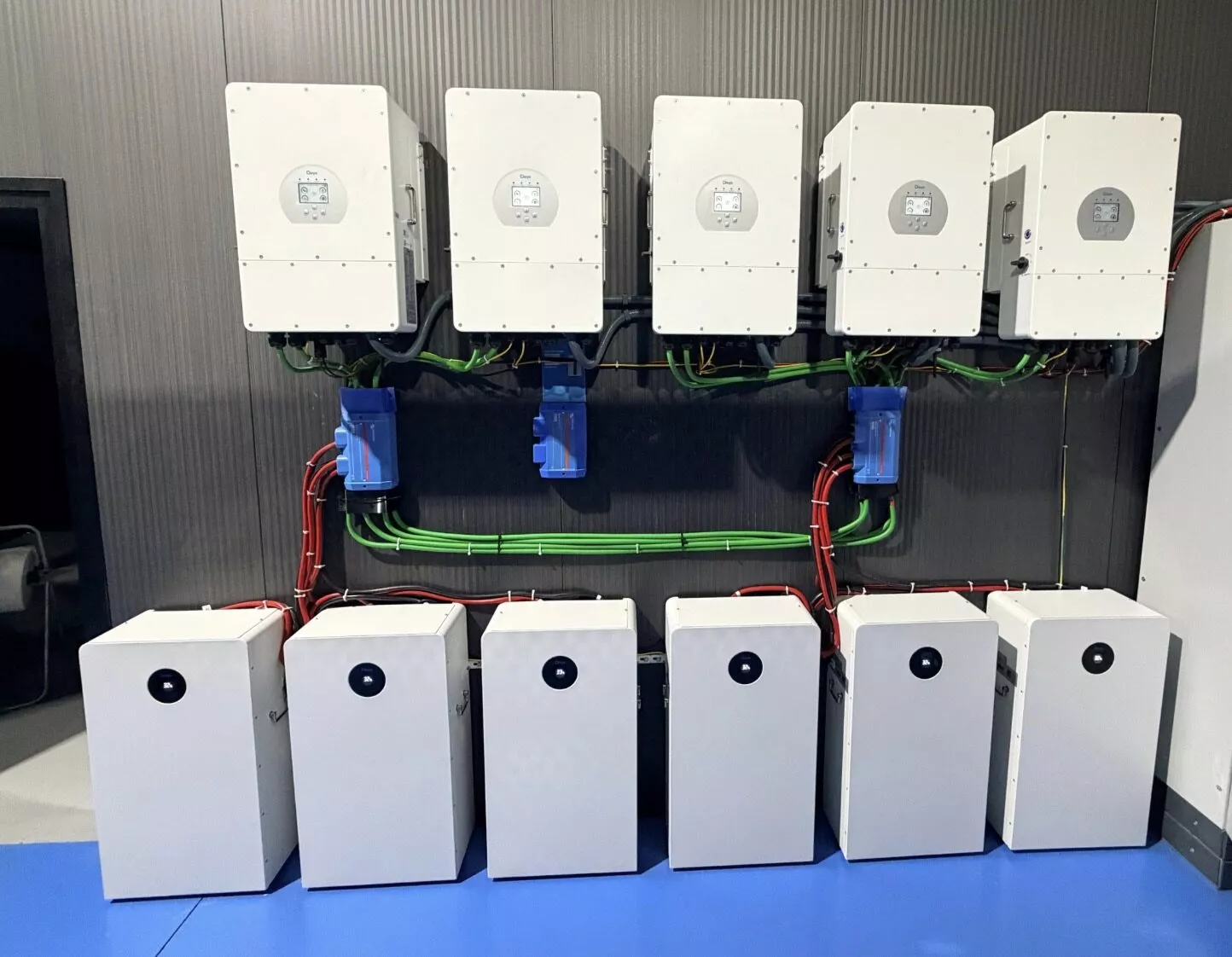
Contracted power of 30 kW with peaks of up to 90 kW. 5 inverters of 15 kW and 6 batteries of 16 kWh trim grid demand in real time: the factory runs at full capacity and the grid never sees more than 30 kW.

Novelda, Alicante
An east-west pitched structure and solar charging for the vehicle fleet.

Cehegín, Murcia
An off-grid agricultural irrigation system replacing a diesel generator.
Three scenarios illustrating different business needs. These are not completed installations or measured results.
Simulation
Demand is concentrated during working hours: compare solar generation with machinery use.
Simulation
Refrigeration also uses energy at night: assess daytime coverage and the energy still supplied by the grid.
Simulation
A large roof and variable demand: match installation size to actual consumption.
Calculation assumption: 1,500 kWh per kWp per year, multiplied by the capacity of each example. Site-specific losses, shading and a location assessment are not included. Self-consumption and savings require analysis of each business’s consumption profile and tariffs.
An industrial solar project has four phases: energy audit, proposal using real data, turnkey installation and continuous monitoring. The schedule is set after checking capacity, roof, grid connection and permits.
We review the bill, load curve, contracted capacity, reactive power and roof.
We calculate savings, exact sizing and the payment model from your data.
Engineering, permits, grants and works, planned around production and weekends.
We check every PV string each night to protect the system's return.
In 2026, qualifying businesses may use accelerated or free tax amortisation, regional self-consumption grants when calls are open, and local IBI rebates. A Todo Sol checks and processes available incentives as part of the turnkey project.
Availability and eligibility are checked for each business before any incentive is included in the proposal.
Applied only where the investment and company meet current tax requirements.
We submit applications when a call is open and the project qualifies.
We check the tax ordinance in the relevant municipality.
We assess CAEs only for eligible measures; pure solar generation is not promised as eligible.
A Todo Sol installs industrial self-consumption across eastern Spain for logistics, food, footwear, marble, plastics, cold storage and other sectors.
A broken panel is visible from the ground. A blown fuse is not: the system stays on and produces half. We compare every string against the voltage it gave the day we installed it, every night. Included for life.
Free, no-obligation energy audit using your real bill and load curve. Saturdays and Sundays included.