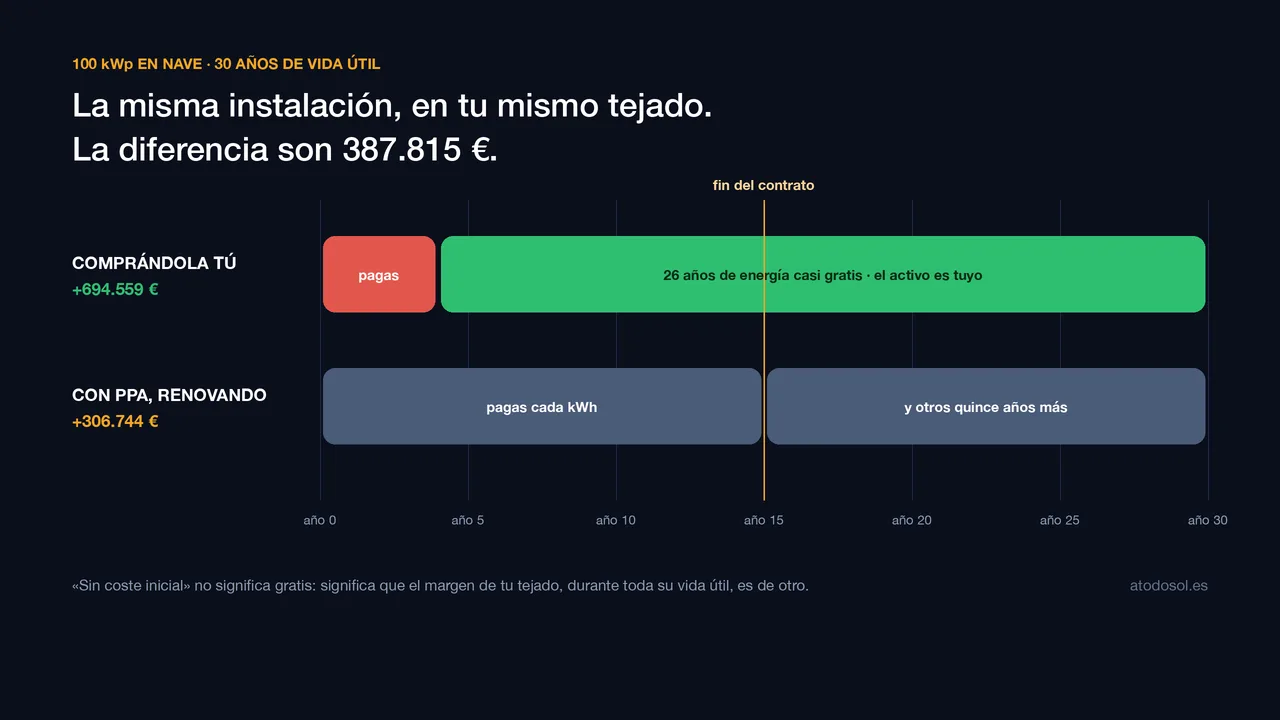
Let us start by being fair: a PPA is not a scam in the criminal sense of the word. It is a legal contract, signed by adults, and nobody is deceiving you with forged paperwork. The swindle is a different one: the comparison they put in front of you so that you sign. They show you what you pay your electricity supplier today against what you would pay with them, and together you celebrate the saving. The one comparison nobody ever puts on the table is the only one that matters: what you would make if that same system were yours.
That gap is where the money stays. And it is fifteen or twenty years' worth of money. In this article we put it in euros, year by year.
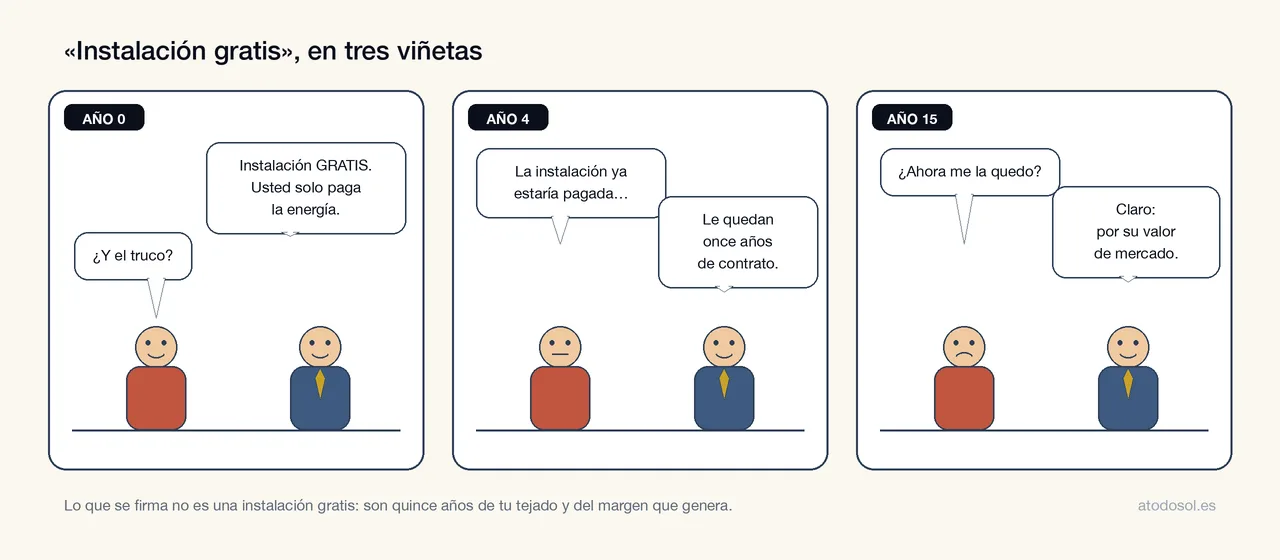
First: there are two different things called a “PPA”
They are worth separating, because the salesman mixes them up on purpose.
An off-site PPA is a long-term power purchase agreement with a plant that sits somewhere else. You buy energy from the market at an agreed price for years. It is the classic tool large consumers use to lock in a price, and it makes perfect sense when it is negotiated properly.
An on-site PPA, or “zero-cost self-consumption”, is another matter entirely: a company installs panels on your roof, with its own money, and for ten, fifteen or twenty years sells you the energy produced on your own roof. You pay nothing at the start. That is what this article is about.
Sharing an acronym does not make them comparable. One is a supply contract; the other is renting you your own roof with a supply contract on top.
The comparison they do not show you
The sales pitch is always the same: “today you pay your supplier €0.18/kWh, with us you will pay €0.10. You save 40% from day one and without investing a euro.” And it is true. The problem is not what they say, it is what they keep quiet about.
A photovoltaic system on an industrial roof is one of the fastest and most predictable investments there is: the industry works with payback periods of between three and six years for industrial loads with a good daytime profile. After those years, the cost of the energy your roof produces is, essentially, the maintenance.
And there is a second trap in the time frame: the contract runs for fifteen years, but the system lives for thirty. Today's panels carry twenty-five or thirty-year output warranties. Comparing only the term of the contract is comparing half the film.
Put the two lines side by side over the real service life:
- If you buy it: you pay for the system, it pays for itself in three to six years and you are left with more than twenty years of practically free energy. The system is an asset of yours — depreciable, financeable, and worth more every year that electricity goes up.
- With the PPA: you pay nothing at the start, you save a percentage every year and, for fifteen of them, the margin between what it costs them to produce and what you pay them is theirs, in full. When the contract ends, you either buy a second-hand system or sign up for another fifteen years.
A PPA does not spare you the investment: it charges you for it in easy instalments, with the middleman's margin inside, and without the asset ever becoming yours. Looked at that way, “no upfront cost” means exactly what it would mean on a car or on an industrial unit: finance, not a gift.
The numbers, in euros and year by year
Enough adjectives. Let us take a concrete case and show the cash, over thirty years, which is how long the system lasts. These are the assumptions, and they are here so that you can redo the calculation with your own:
- System: 100 kWp on the roof of an industrial unit, €75,000 turnkey (€0.75/Wp).
- Output: 1,550 kWh per kWp a year (a well-oriented roof in Alicante), with 88% self-consumed → 136,400 kWh in the first year, and 0.5% less each year through degradation.
- What that kWh from the grid costs you today: €0.16, everything included.
- Electricity price escalation: 2% a year. That kWh at €0.16 today is paid at €0.28 in year 30. We will come back to this assumption, because it is the most debatable of the lot.
- Maintenance and insurance if the system is yours: €750 a year, also rising by 2%.
- Inverter replacement: €9,000 in year 13 and another €9,000 in year 26, paid by whoever owns it at the time.
- PPA: €0.10 per kWh produced and consumed, with a 2% annual review and a fifteen-year contract.
And since the PPA ends in year 15 but the roof is still there, we have to say what happens afterwards. Three scenarios:
- A — You buy it. You pay €75,000 and it is yours from day one.
- B — PPA and then you buy it. Fifteen years of contract and at the end you exercise the purchase option for a residual €7,500. The PPA's good scenario: it assumes the option exists, that the price is reasonable and that they do sell it to you.
- C — PPA and you renew. Fifteen years, and another fifteen on a new contract at the same relative discount. The realistic scenario if you never want to tie up capital.
| Year | kWh | €/kWh grid | Buy: cum. | PPA+buy: cum. | PPA+renew: cum. |
|---|---|---|---|---|---|
| 0 | — | — | −€75,000 | €0 | €0 |
| 1 | 136,400 | 0.1600 | −€53,926 | €8,184 | €8,184 |
| 2 | 135,718 | 0.1632 | −€32,542 | €16,490 | €16,490 |
| 3 | 135,039 | 0.1665 | −€10,843 | €24,920 | €24,920 |
| 4 | 134,364 | 0.1698 | €11,175 | €33,475 | €33,475 |
| 5 | 133,692 | 0.1732 | €33,518 | €42,158 | €42,158 |
| 6 | 133,024 | 0.1767 | €56,189 | €50,970 | €50,970 |
| 7 | 132,359 | 0.1802 | €79,193 | €59,913 | €59,913 |
| 8 | 131,697 | 0.1838 | €102,536 | €68,990 | €68,990 |
| 9 | 131,039 | 0.1875 | €126,223 | €78,202 | €78,202 |
| 10 | 130,383 | 0.1912 | €150,258 | €87,551 | €87,551 |
| 11 | 129,731 | 0.1950 | €174,646 | €97,040 | €97,040 |
| 12 | 129,083 | 0.1989 | €199,393 | €106,670 | €106,670 |
| 13 | 128,437 | 0.2029 | €215,504 | €116,443 | €116,443 |
| 14 | 127,795 | 0.2070 | €240,985 | €126,362 | €126,362 |
| 15 | 127,156 | 0.2111 | €266,840 | €128,929 | €136,429 |
| 16 | 126,520 | 0.2153 | €293,075 | €155,164 | €146,646 |
| 17 | 125,888 | 0.2196 | €319,696 | €181,785 | €157,015 |
| 18 | 125,258 | 0.2240 | €346,709 | €208,798 | €167,538 |
| 19 | 124,632 | 0.2285 | €374,119 | €236,207 | €178,218 |
| 20 | 124,009 | 0.2331 | €401,931 | €264,020 | €189,058 |
| 21 | 123,389 | 0.2378 | €430,153 | €292,241 | €200,059 |
| 22 | 122,772 | 0.2425 | €458,789 | €320,878 | €211,224 |
| 23 | 122,158 | 0.2474 | €487,846 | €349,935 | €222,555 |
| 24 | 121,547 | 0.2523 | €517,330 | €379,419 | €234,055 |
| 25 | 120,940 | 0.2573 | €547,248 | €409,337 | €245,726 |
| 26 | 120,335 | 0.2625 | €568,605 | €430,694 | €257,572 |
| 27 | 119,733 | 0.2677 | €599,408 | €461,497 | €269,594 |
| 28 | 119,135 | 0.2731 | €630,664 | €492,752 | €281,795 |
| 29 | 118,539 | 0.2786 | €662,378 | €524,467 | €294,177 |
| 30 | 117,946 | 0.2841 | €694,559 | €556,648 | €306,744 |
| 30 years | 3,808,719 | — | €694,559 | €556,648 | €306,744 |
Highlighted rows: year 4 (the purchased system has paid for itself), year 15 (the PPA ends) and year 16 (the second half of the service life begins). The “€/kWh grid” column includes the 2% annual escalation.
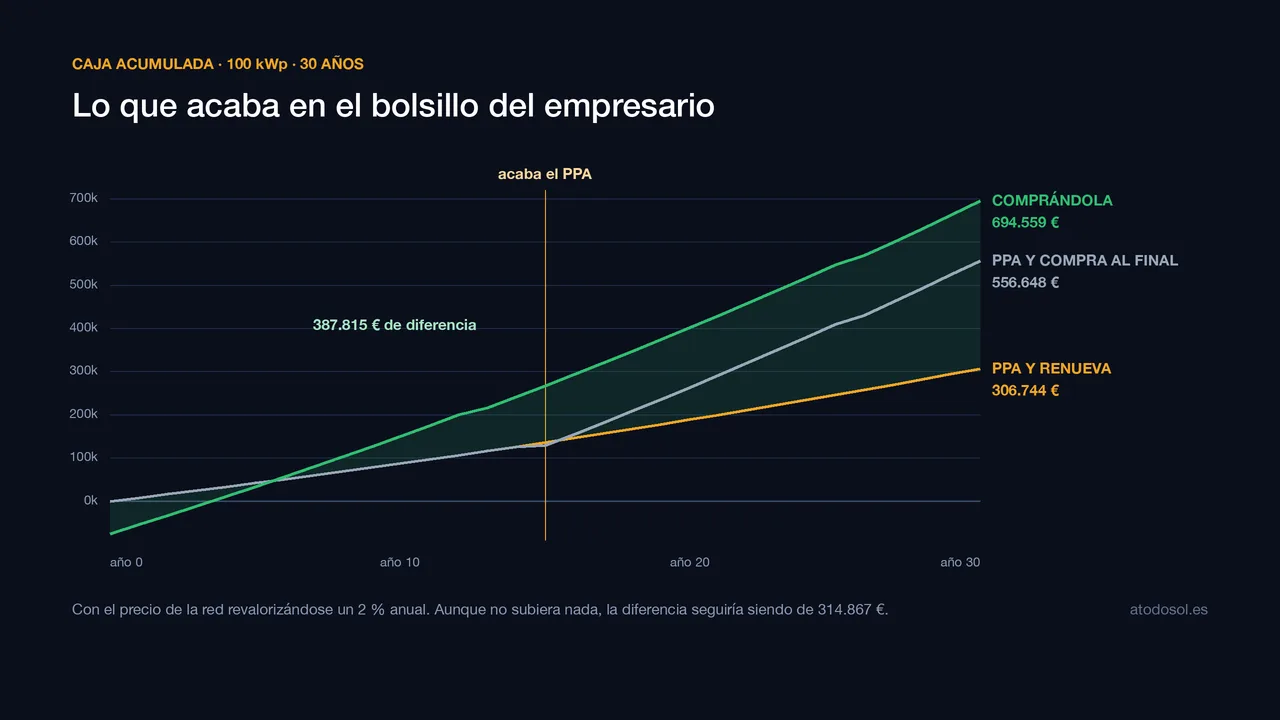
The totals, which are what sticks
- A, buying it: −€75,000 on day one, paid off during year 4, and +€694,559 accumulated at thirty.
- B, PPA and then purchase: +€556,648. You lose €137,911 against buying it, which is what renting out your own roof for the first fifteen years costs you.
- C, PPA and you renew: +€306,744. You lose €387,815: more than five times the cost of the system.
Put in a more uncomfortable way: that roof generates €817,985 of avoided bills over thirty years. In scenario C, you keep 37% of it and the rest goes to the operators of the contract. In the first fifteen years alone you pay €227,381 to the first of them — three times what the entire system cost.
Look at where the curves cross in the table: around year 7, buying is ahead for good. From then on the gap grows every year, and it grows faster the more electricity prices rise.
The escalation assumption, which is the most debatable one
We have just published that wholesale electricity prices in Spain are falling: more than 500 hours at negative prices in 2026 and an average 16% below 2025. Is it not contradictory to assume electricity rises by 2% a year?
No, and it is worth understanding why: what is falling is the energy term, which on an industrial bill is only one part. Grid tolls, charges, metering rental and taxes go their own way, and that way has been heading upwards for years. Even so, since the assumption is debatable, here is the same calculation under four different hypotheses, over thirty years:
| Annual electricity price escalation | Buying it | PPA and you renew | Difference |
|---|---|---|---|
| 0% (electricity never rises) | €485,969 | €171,102 | €314,867 |
| 1% | €580,532 | €231,715 | €348,817 |
| 2% (the one used above) | €694,559 | €306,744 | €387,815 |
| 3% | €832,420 | €399,871 | €432,549 |
The conclusion does not depend on the assumption. Even in the scenario most favourable to the PPA — electricity frozen for thirty years, something that has never happened — buying the system leaves €314,867 more in the business. What the escalation does is widen the gap: the more electricity prices rise, the more expensive handing over your roof turns out to be.
Let us be fair to the PPA
Three qualifications, because this calculation has to survive being read by the PPA salesman:
- You do not lay out €75,000. That money can stay in your business. If your company earns a better return putting it into stock, machinery or sales than the 20%-plus a year the system yields, the decision changes. Put in your own figure.
- The technical risk is not yours. If the system underproduces, that is the operator's problem; the €18,000 of inverters in years 13 and 26 are on him while his contract lasts. Careful, though: that only holds if the contract has guaranteed availability in writing, with a penalty attached.
- The assumptions rule. If your real self-consumption is 60% rather than 88%, or your grid kWh costs €0.11 rather than €0.16, the numbers narrow. Even so, the conclusion rarely flips over: whoever buys the system keeps two or three times more money.
What is not up for debate is the order of magnitude. And that is why the salesman compares you with this month's bill and not with this table.
And then there is the price, which in 2026 is a devastating argument
Here comes the figure worth keeping in mind when you read an offer: solar PPAs in Spain are being signed at around €32.50/MWh — some €0.0325/kWh — the lowest in Europe since 2021, after falling 16.6% in the last quarter of 2025. In some contracts, between €30 and €35/MWh. In Germany they run at about €49.7; in Italy, €60.7; in France, €63.4. Spain is the cheapest market in Europe in which to buy solar energy long term.
Careful: that is not a direct comparison with what they are offering you, because that price is energy on the market, without tolls, charges or taxes, whereas the energy from your roof saves you the full bill. They are not the same thing and it would be dishonest to pretend otherwise. But it does tell you one very concrete thing: producing a solar kWh in Spain costs next to nothing today. If they are selling it to you at €0.09, €0.10 or €0.12 per kWh produced on your own roof, using your surface, your insurance and your signature on a fifteen-year contract, ask yourself who is pocketing the difference between that cost and that price.
And falling prices have a second effect: the Spanish electricity market has already racked up more than 500 hours of negative prices in 2026 and a forecast average price of €54.55/MWh, 16% below 2025. Any long-term contract at a fixed price or indexed to inflation that you sign today ages against you if energy keeps getting cheaper. You are the one taking that risk, for fifteen years.
The small print you have to read twice
Not all contracts are the same, and some are well drafted. These are the clauses where it is decided whether yours is:
- Term and automatic renewal. Ten years is already a lot; twenty is half the service life of the building. Check whether it renews by itself unless notice is given, and how far in advance you have to give it.
- Termination penalty. This is where it hurts. If early exit is calculated as the present value of all the remaining payments, you do not have an exit clause: you have a sentence. Look for “break fee” or “indemnity for early termination” and work out the actual figure for year 3, year 7 and year 12.
- Take-or-pay. You commit to consuming a minimum volume. What if you cut output, change shift patterns, close in August or install more efficient machinery? Without flexibility bands, you pay for energy you do not consume.
- Price and indexation. Fixed, indexed to the IPC (the Spanish consumer price index), reviewable? Compound inflation over fifteen years multiplies more than people intuitively expect.
- Purchase option. Almost all of them promise that at the end you keep the system “for a very low residual value”. A salesman's promise is worth nothing: the exact formula has to be in the contract. If it says “at market value, to be determined by the owner”, you do not have a purchase option: you have a future negotiation with the party holding all the cards.
- Roof transfer or surface right. This is the most serious point and the least read. If the contract creates a derecho de superficie (a surface right) over your roof — usually for 25 or 30 years, and registrable at the Registro de la Propiedad (the Spanish land registry) — what sits on top of your roof stops being yours for that period, and the charge travels with the property. It also has tax consequences: creating that right is a supply of services subject to IVA (Spanish VAT).
- What happens if you sell the building. Can you sell with the contract inside? Is the buyer obliged to take it over? And if he does not want to? A twenty-year contract over your roof is a liability that shows up in any serious buyer's due diligence.
- Assignment of the contract by them. Many of these contracts end up packaged and sold to a fund. Did you sign with a local company only to be dealt with in year 4 by a servicer who does not pick up the phone? Check whether they can assign the contract without your consent.
- Roof, works and liabilities. Who pays if the roof under the panels has to be repaired? Who takes the panels off and puts them back? And if you want to extend the building, fit a skylight or an extractor? Many contracts effectively ban you from touching your own roof.
- Guaranteed availability and who monitors it. If the party being paid for energy produced is the same one who decides when repairs happen, you need an availability guarantee with a penalty, not a promise.
When a PPA does make sense
It would be dishonest to say “never”. There are clear cases:
- You have no access to finance and the real alternative is not buying the system, it is having no system at all.
- The roof is not yours and the lease on the building is short or uncertain: putting your own investment in there is debatable.
- Your company cannot or will not capitalise CAPEX because of group policy, and prefers to pay a predictable OPEX even if it costs more in the long run. That is a legitimate financial decision, as long as it is taken with the numbers in front of you and not in the belief that it is free.
- Off-site, to cover a large consumption at a stable price for years: a different league, a different contract, and normally with a specialist adviser.
Outside those cases, for an SME with its own building, a sound roof and daytime consumption, the on-site PPA is usually the most expensive way of having solar panels.
What almost nobody tells you: buying today is easier than you think
The PPA argument rests on the idea that the investment is a wall. In 2026, for a company, it is not that much of one:
- Free depreciation. Real Decreto-ley 7/2026 (a Spanish royal decree-law) keeps free depreciation in corporate income tax for investments in renewable self-consumption systems commissioned in 2023, 2024, 2025 and 2026. In plain terms: you can write the investment off for tax far sooner than you depreciate it in the accounts.
- Bank finance and leasing backed by the system itself and by the savings it produces, with a clear purchase option and over terms far shorter than fifteen years.
- Grants and funding rounds, which do exist and keep changing — and which in a PPA, mind you, usually go to whoever owns the system, that is to say, not you.
The ten questions before signing
- How much would it cost to buy this same system, turnkey?
- Over how many years does it pay for itself given my real consumption, bill in hand?
- How much will I pay in total over the whole life of the PPA contract?
- What exactly is the formula for the purchase option, and what does it come to in year 5 and in year 10?
- How much does it cost me to walk away in year 3? And in year 7?
- Is a surface right created? Is it registered at the Registro de la Propiedad? For how many years?
- Can I sell the building without a penalty, and what obligations does the buyer inherit?
- Can they assign the contract to a third party without my consent?
- Who is liable for the roof, for taking the system down for building works, and for the insurance?
- What availability do they guarantee me in writing, and what do they compensate me with if it is not met?
If they answer the first question evasively, you already know what the rest of the conversation is worth.
Our position, with no pretence
We are installers: we sell installations, so read us with that label on. Precisely for that reason we say it plainly: it is in your interest to own your roof and what sits on it. We would rather sell you a system of your own, with its warranty, its maintenance and its monitoring, than land you with a fifteen-year contract in which the asset never becomes yours.
And if after reading this you still think the PPA is your case, bring us the contract before you sign it. We will tell you which clauses are going to hurt, even if you end up signing with somebody else.
Request your no-obligation study · or write to us on WhatsApp · 692 22 97 13
Sources: Spanish solar PPA prices and the European index, El Periódico de la Energía and LevelTen Energy (fourth-quarter 2025 data, published in 2026); negative prices and the forecast average price for 2026, financial and energy trade press (August 2026); free depreciation, Real Decreto-ley 7/2026 of 20/03/2026 (BOE no. 71, of 21/03/2026), seventeenth additional provision of the Spanish Corporate Income Tax Act; nature and taxation of surface rights over roofs, published commentary from specialist law firms. This article is not legal or tax advice: before signing a fifteen-year contract, have your solicitor read it.