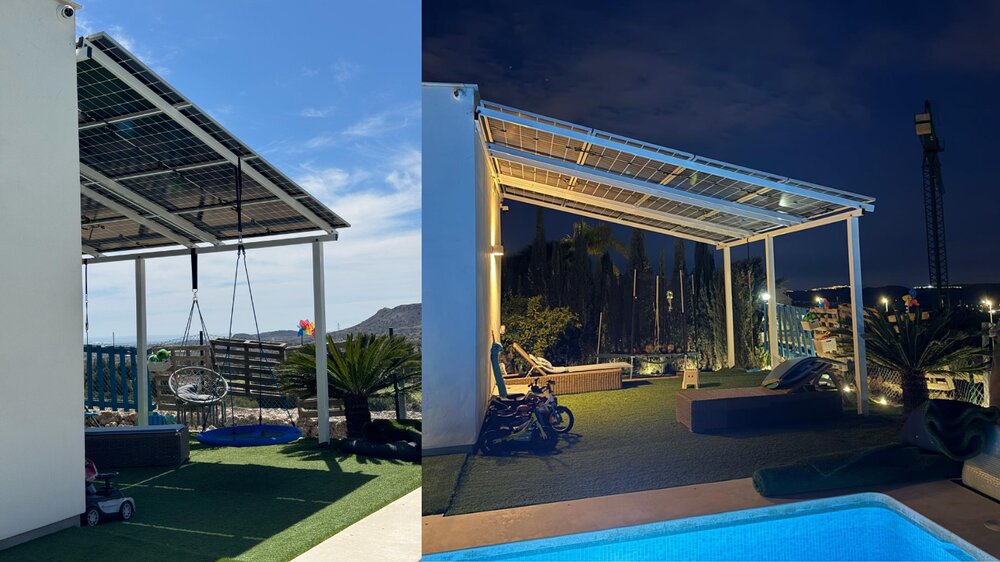
Having a house at the beach, in the mountains or in a village is a privilege… but it also means fixed costs all year round. And here comes the question we get asked all the time: is it worth installing solar panels in a second home that I only use at weekends or on holidays?
The short answer: in most cases, yes. But not for the reasons you might imagine. Let's break it down.
Your house consumes energy even when you're not there
Even if you only go 20-40 days a year, the property stays connected to the grid for all 365. The fridge, the router, the alarm, the electric water heater, the automatic irrigation, the pool pump… That "vampire consumption" is usually between 300 and 800 kWh per year, paid at full price: €60 to €160 a year just on standby, plus the fixed charges.
With solar panels, that base consumption is covered by your own energy even when you're away. That's the first saving, and it happens every day of the year — not just when you're there.
The weekend is when the sun shines most
Use of a second home concentrates on Saturday and Sunday, almost always during the central hours of the day: air conditioning, cooking, pool, showers. In other words, your consumption peak matches your solar production peak. That match is exactly what makes self-consumption profitable: you don't need to export surplus to the grid, you use the energy directly.
And in summer — when you spend the most time at the house — the installation produces the most. A match again.
How to size it (it's not like a main home)
The typical mistake is sizing the installation as if you lived there all year. For a second home the logic is different:
- Calculate based on the consumption of your days of use plus the yearly standby, not on a main-home bill.
- Better slightly undersized than oversized: surplus is credited on your bill, but at a lower price than what you pay to consume.
- South-facing if possible, and if there's no good roof, a solar pergola does two jobs: shade for the terrace and energy production.
Battery: yes or no?
Here the answer is more nuanced. If your weekend consumption is mostly daytime (pool, air conditioning), the battery adds little: you consume what you produce. But there are two cases where we do recommend it:
- If you worry about the house losing power while empty: alarm, cameras and fridge keep running during an outage. Our batteries feed the critical loads with instant switchover.
- If your consumption is at night (electric heating in winter, for example).
In all other cases, starting without a battery and evaluating it later is the most cost-effective option.
Monitoring: see your house from the city
All our installations include app-based monitoring. For a second home it's especially useful: you can see production, consumption and whether anything has switched off — including a grid outage — without travelling. It's the cheapest way to know everything is fine from 200 km away.
An example with real numbers
Country house used three weekends a month plus one month in summer:
- Estimated yearly consumption: 2,200 kWh (about 1,400 on standby, the rest real use)
- System: 8 panels (~3.6 kWp) without battery, from ~€4,500
- After the 60% income-tax deduction: ~€1,800 net cost
- Yearly savings: ~€400 between standby and direct use
- Payback: about 5 years, for an installation that lasts over 30
If there's also a pool or air conditioning, payback drops to 3-4 years.
And the surplus?
Whatever you produce and don't use is exported to the grid and discounted from your bill (simplified compensation). In a second home it won't make you rich, but it adds up: it's normal for the bill in months with no use to end up being almost only the fixed charge.
Conclusion
A second home is one of the cases where savings are most noticeable, precisely because standby is paid for all year and usage matches the sunniest hours. If you want numbers for your specific case, try our savings calculator in 30 seconds, or see how we build our solar panel installations.