
If you are looking up information about bioclimatic pergolas, you probably want what thousands of property owners in Spain want: a more usable terrace, protection from sun and rain, and an outdoor space you can enjoy all year round.
And it makes total sense. Bioclimatic pergolas are a well-established solution that delivers on those goals.
But what if, on top of all that, you could also produce your own electricity? That is exactly what a solar (photovoltaic) pergola offers: the same advantages of a bioclimatic one, plus a real return on investment that can pay for itself in 3 to 6 years, depending on consumption and tax deductions.
In this article we explain what each one is, compare their advantages with real data and help you decide which is the best option for your case.
What is a bioclimatic pergola?
A bioclimatic pergola is a structure with adjustable louvres (typically aluminium) that let you regulate the entry of light and natural ventilation. By rotating the louvres you control how much sun comes in, how much air circulates and, when they are closed, they offer full rain protection.
Main advantages of a bioclimatic pergola:
- Light and ventilation control through adjustable louvres
- Rain protection with closed louvres
- An expanded outdoor living space
- A variety of designs and aesthetic finishes
- An increase in property value
It is an excellent choice for anyone looking for comfort. But it stops there: it does not produce energy, it does not pay back the investment, and it does not give access to energy subsidies.
What is a solar (photovoltaic) pergola?
A solar pergola integrates photovoltaic panels into its structure, which lets it generate clean electricity while providing shade and protection. In other words: it serves the same function as a bioclimatic one, but adds an energy-generation component that turns it into an investment with a return.
Everything you wanted from a bioclimatic, plus:
- Generates between 3,000 and 10,000 kWh/year (depending on size and location)
- Electricity bill savings of €700 to €3,000/year
- Payback in 3 to 5 years (without counting subsidies and aid)
- Access to subsidies and tax breaks (council tax, building tax, income tax)
- Property revaluation between 3% and 6%
- Direct contribution to CO₂ emission reduction
- 25-year energy production warranty
- Customisable design: complete aesthetic integration with the home
Comparison: bioclimatic vs solar residential pergola
| Feature | Bioclimatic pergola | Solar (photovoltaic) pergola |
|---|---|---|
| Shade and sun protection | Yes | Yes |
| Rain protection | Yes (closed louvres) | Yes (fixed panels) |
| Ventilation control | Yes (adjustable louvres) | Partial (open design) |
| Generates electricity | No | Yes (3,000–10,000 kWh/year) |
| Annual bill savings | — | €700 – €3,000/year |
| Payback | Does not pay back | 3–5 years |
| Available subsidies | No (with rare exceptions) | Yes (up to 40–50% in many regions) |
| Council tax (IBI) discount | No | Yes (up to 50% depending on the council) |
| Income tax (IRPF) deduction | No | Yes (up to 20–60%) |
| Production warranty | Not applicable | 25 years |
| Property revaluation | Moderate | High (3–6%) |
| Indicative price (20 m²) | €4,000 – €8,000 | €6,000 – €12,000 |
| Net cost (after subsidies) | €4,000 – €8,000 | €2,000 – €6,000 (in some cases €0) |
* Indicative figures. Subsidies vary by region and municipality.
Key insight: if you have access to subsidies (which can cover 30% to 50% of the cost), the net price of a solar pergola can be lower than that of a conventional bioclimatic one. And from year 3–5 onwards, everything it generates is pure savings.
Real savings: numbers that speak for themselves
Let's put a concrete example for a home in the Valencian Community with an 18.5 m² solar pergola:
- Installed power: 4.2 kWp
- Estimated annual production: 5,600 kWh
- Annual savings on the electricity bill: €1,500/year
- Installation cost (no subsidy): €6,300
- Estimated subsidy (Next Generation / regional): −€2,500 to −€4,000
- IBI discount (50% for 5 years): −€1,000 to −€2,500
- IRPF deduction (20–40%): −€1,600 to −€4,000
- Real net cost: €2,000 – €4,000
- Payback period: 1.5 – 3 years with subsidies
- Cumulative savings over 30 years: €47,000
Note: Subsidy and discount amounts vary by region and municipality. These figures are estimates based on the schemes in force in 2024–2025. At A Todo Sol we handle the application for every aid available for your specific case.
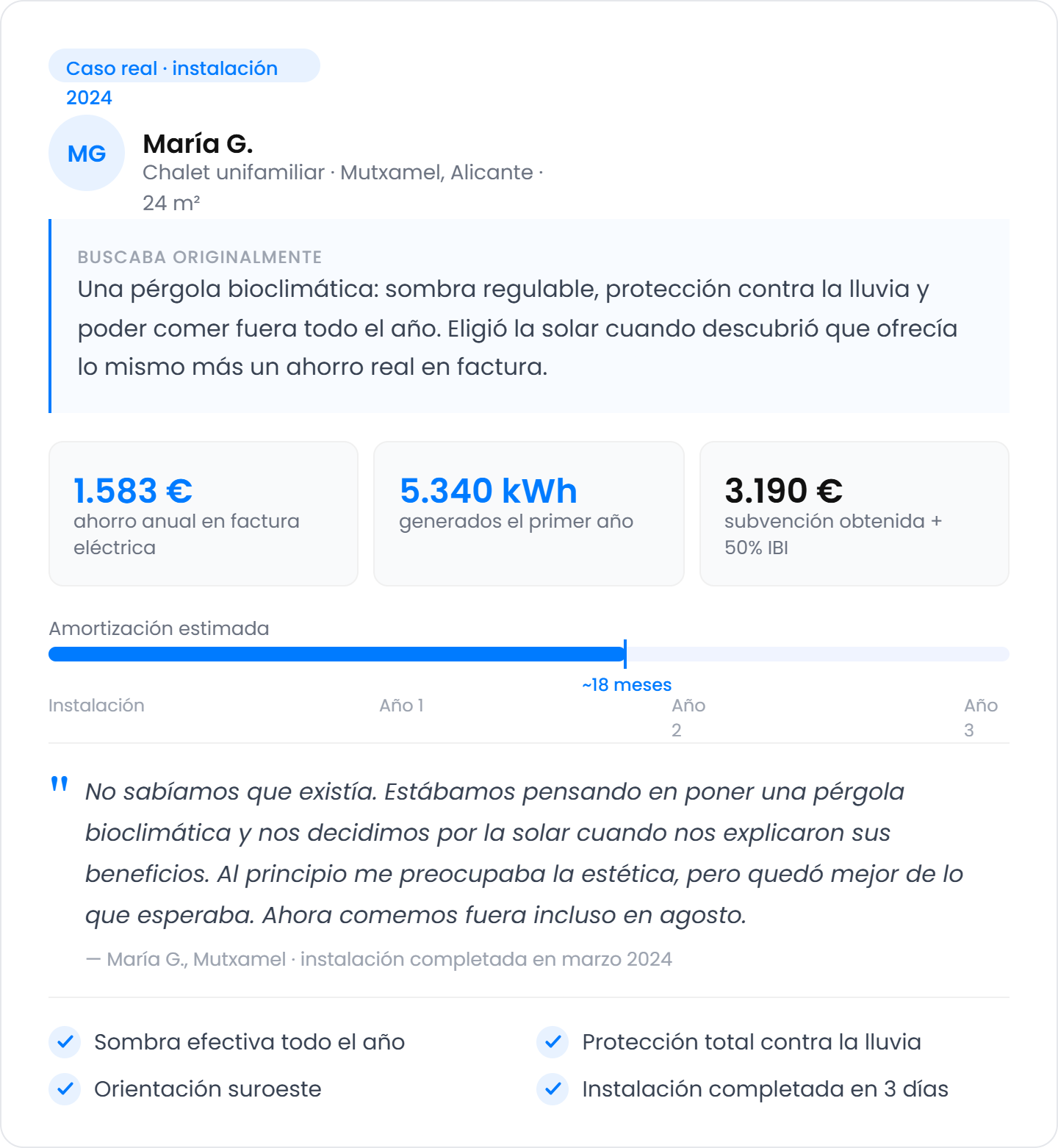
Real case: "I was looking for a bioclimatic and ended up choosing solar"
When to choose a bioclimatic and when a solar pergola
Let's be transparent. A solar pergola is not always the best option. It depends on your situation:
A bioclimatic pergola may be your best choice if:
- You only want adjustable shade and have no interest in generating energy
- Your terrace faces north and gets few hours of direct sunlight
- You are not connected to the electrical grid and not interested in batteries
- Your budget is very tight and you cannot tap into subsidies
A solar pergola is the better option if:
- You want shade and to also reduce your electricity bill
- You want the investment to pay back (and generate net savings long-term)
- You want to access subsidies, IBI discounts and IRPF deductions
- You want to revalue your home with a certifiable energy improvement
- You care about sustainability and reducing your carbon footprint
And what about aesthetics? Adaptable, customisable design
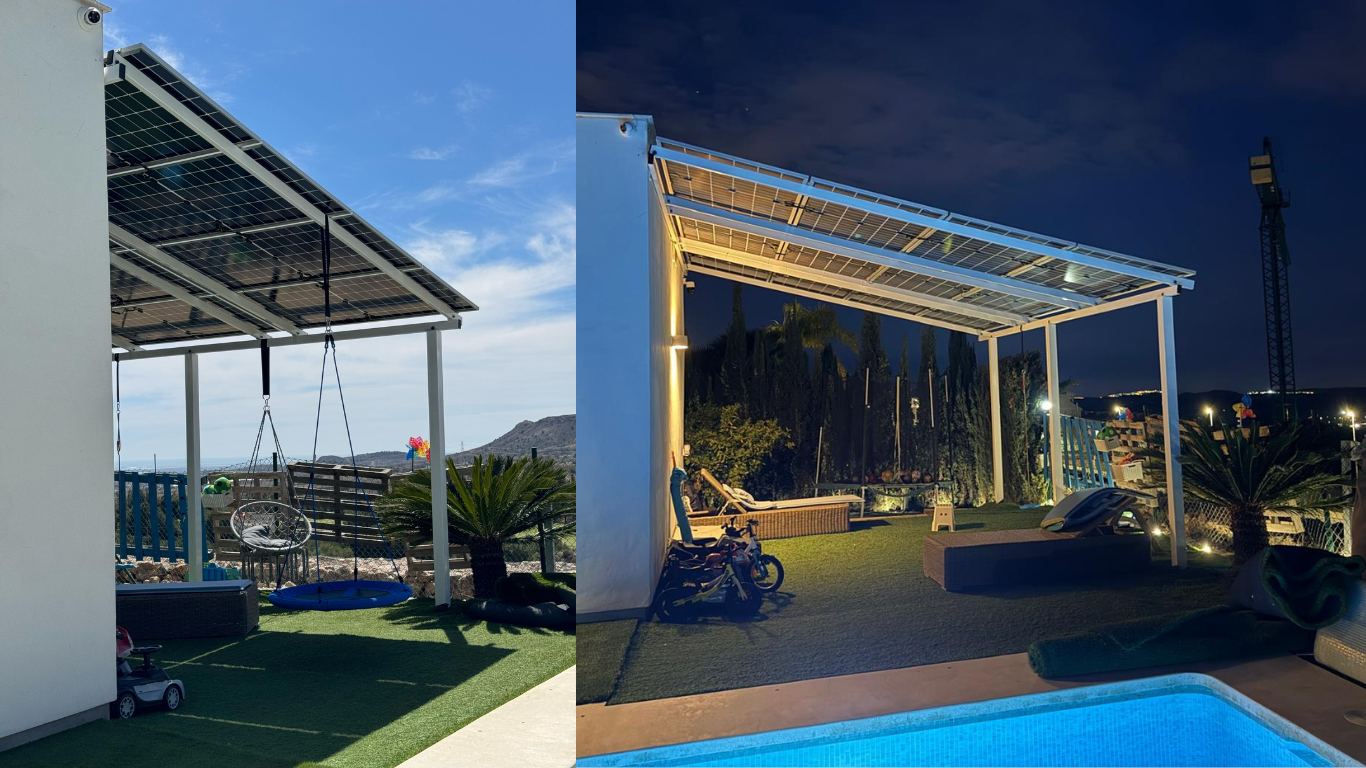
One of the most common worries is whether a solar pergola "looks good". The answer is yes. Today's solar panels integrate cleanly into the structure, with finishes in black, graphite or tones that match the home's architecture.
A Todo Sol's solar pergolas are designed to measure, with high-strength galvanised steel structures and the latest-generation panels that combine energy performance with a minimalist finish. The visual result is a modern, elegant pergola.
Subsidies and aid: the decisive advantage
This is probably the most important and least known factor. Solar pergolas, being photovoltaic installations, give access to a package of incentives that conventional bioclimatic pergolas do not offer:
- Direct subsidies (Next Generation / regional): can cover 30% to 50% of the installation cost.
- IBI (council tax) discount: many municipalities offer up to 50% off council tax for 3 to 5 years.
- IRPF (income tax) deduction: between 20% and 60% of the cost, depending on the certified energy improvement.
- ICIO discount: up to 95% off the local construction tax.
In some cases, the full package of aid can reduce the real cost to ZERO.
FAQ: bioclimatic vs solar pergola
How much does a bioclimatic pergola cost compared to a solar one?
A 20 m² bioclimatic pergola costs €4,000 to €8,000. A solar one of the same size, €6,000 to €12,000. After applying subsidies (30–50%), IBI discounts and IRPF deductions, the net cost of the solar one can sit between €2,000 and €4,500, making it cheaper than the bioclimatic in many cases.
Which one pays back?
Only the solar pergola pays back, since it produces electricity that you subtract from your bill. The typical period is 3 to 5 years without subsidies, and 1.5 to 3 years with them. A bioclimatic is an expense you do not recover.
Do they both protect equally from sun and rain?
Yes, both offer effective protection. The bioclimatic stands out for ventilation control with adjustable louvres. The solar one offers full shade and electricity generation at the same time. Both protect from rain.
Which adds more value to my home?
The solar pergola adds more value on two fronts: it improves the outdoor space and it improves the energy efficiency of the home (energy certificate). The estimated revaluation is 3–6%, against 1–2% for a bioclimatic.
Does a solar pergola look good aesthetically?
Yes. Modern solar pergolas use the latest-generation panels with elegant finishes (black, graphite) that integrate into the structure. They are designed to measure for each home, achieving a visual result that is comparable to or better than bioclimatic ones.
What maintenance do they need?
Both require minimal maintenance: periodic cleaning and a check of the mechanisms. The solar pergola has the added advantage of a 25-year energy production warranty.
Why settle for just shade?
Request your free study. Installation commitment within 30 days. 25-year production warranty. No surprises.